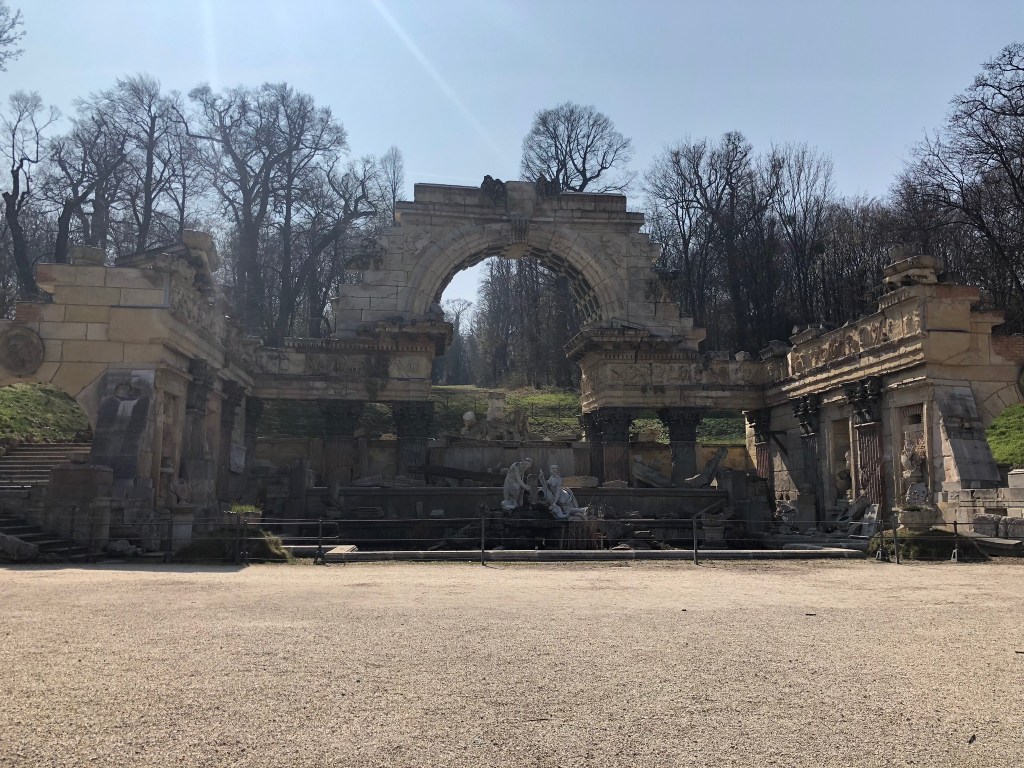
In the vast gardens of Schönbrunn Palace in Vienna, at the end of one of the many gravel pathways, is the Roman Ruin. A pale yellowy arch, held aloft by the typical tree-trunk pillars and flanked by two walls which create a kind of courtyard. Scattered everywhere are chunks of stone and broken ornaments, the decoration on pillars and walls are cracked and everything was layered with the dirt of passed time. Turns out, none of this stuff is Roman. It’s not even technically a ruin. It is a scene, carefully constructed in 1778 to look like a ruin from antiquity. This practice wasn’t even uncommon, the fuck-off-rich people of the 18th Century often turning to the fake ruin as the pièce de résistance of their massive gardens.

Although I’d like to say I knew straight away that it was definitely fake, that I could recognise the materials weren’t as old as they ought to be, I really wasn’t sure . But once I found out after, and thought about it a little bit, it seemed quite ridiculous to me. I (as illustrated by the content of this blog) love old stuff but would I want to have a fake old thing built, at huge expense, in my back garden? Isn’t the appeal of old things that they’re actually old, that you have something that brings you closer to history, an object enchanted by the passing of time.
But the more I thought about it, the less strange and more familiar the idea seemed. Last year I had a weekend in Grantham and stayed at a very beautiful hotel with a garden; tightly cut grass sat underneath old, stoic trees and a neat path traced through it. Having seen the pictures beforehand, I packed a pair of trousers, a white linen shirt and a pair of brown brogues and for parts of the trip I pretended in my mind to be a character in a Poirot novel. This was heightened by the fact that we went to a speakeasy-themed cocktail bar and got suitably drunk. Now obviously I know that it wasn’t a real speakeasy, and that the facilities of this hotel far exceeded those of an Interwar equivalent, but it was fun play pretend and to indulge in the feeling of history. It isn’t always about veracity or authenticity but also mapping those conceptions we hold about periods of time onto our own lives and bathing in that kind of nostalgia. While I was dressing up binge-drinking as a classy evening out in a 1920s bar, maybe the Hapsburg’s were borrowing their own associations of antiquity to attach to themselves.
It’s the same compulsion that leads people to take Polaroid photos or even get an app on their phone that mimics a Polaroid. The photo is captured in poorer quality but it also imbues it with a kind of importance and it implies it must be treated with the reverence of an old, special, and thus preserved, object. People makes movies on film, artists record songs on vinyl and, while both can be artistic choices, these processes are often used as a shortcut to nostalgia and significance regardless of the actual content. But of course, the romantic, idealised past is a tool that comes in forms a lot more malignant than Instagram filters.

The irony of the ruins to me is that they have come to mirror the decline Schönbrunn Palace itself. The crumbling Roman scene simultaneously pays homage to the ideals of that time period while acknowledging its decline and the need for it to be succeeded, presumably by the Hapsburg’s themselves. But while I walked around the Palace grounds and saw it full of common people like me, walking past the Emperor’s toilet, uncovering every aspect of their private lives, it showed the same decline the Hapsburg’s saw in the Romans, and the Romans in their predecessors. Both the Roman ruins and the palace itself stood as a kind of benign monument to the past, a way for us to satisfy our obsession with the past but to remember that we have moved on– changed. It amused me to think of the Emperors looking into their garden, disgusted to see me eating a whole packet of Tuc biscuits while listening to a boy playing Oasis songs through a small amp. I think for the most part, times change for the better– dynasties and empires fall and are replaced with different ideals and philosophies– but we must remember that we won’t be exempt from the relentless ‘progress’ of humanity and we will probably be reduced to our most quaint or romantic clichés.
As it so happens, there are some real Roman ruins in Vienna. You can see the remnants of walls and windows but the dirty reds and greys of the old brick walls make this sight a far less glamorous one. But does its realness make it more appealing or more worthy of adoration? I’m personally conflicted. On the one hand, the choice to fake a Roman ruin gives us an insight into the values of the people that desired it, their admiration for the beauty of classical forms and structures, their dancing with the past and its connotations that feels so familiar. But on the other hand, there isn’t really a shortcut to nostalgia. I think the real relics from history earn their feeling of enchantment over time and the people responsible for those relics are stuck with whatever conceptions develop of them and their artefacts. Just as it isn’t the grainy, distorted overlay of a Polaroid that evokes the feeling of love or longing or grief within a picture but the truth and the story that the picture contains.
 Uncultured Review