
Shaw’s Corner: A Lesson in Not Meeting Heroes

The other day I went to Shaw’s Corner. The former residence of Irish playwright George Bernard Shaw; or GBS to his friends (not really). Now I didn’t really know anything about Shaw: I came across him in passing during my undergrad, I knew he wrote Pygmalion, which was adapted into My Fair Lady, but almost nothing else. I was only there because of its proximity to me and my need to try out a new camera, so I went in with an open mind. The house is quite remote, at the end of a series of long, empty roads with blind corners, lined with thick bushes and trees– the fair weather made the journey feel like a summer road trip . You arrive first in the car park, with dusty, crunchy gravel underfoot, a silver food truck and a hut housing all the Bernard Shaw-themed merchandise you could want.

We walked in to the hut and scan our membership cards and left feeling very smug and self-satsfied after being congratulated for having young person’s memberships (for we are the vibrant, promising future of the National Trust). The house itself is obscured by tall hedges along one side of the car park, but once they are rounded the house pops into view. It’s an odd sight. The walls, a reddish-brown brick accented with bright green pipes and window frames, seem to jut out at random and three rooftop chimneys complete its unusual silhouette. It feels like something out of The Hobbit or a Wordsworth poem, the greenery that clings to so much of the walls make it seem like the house itself might have sprouted from the ground.
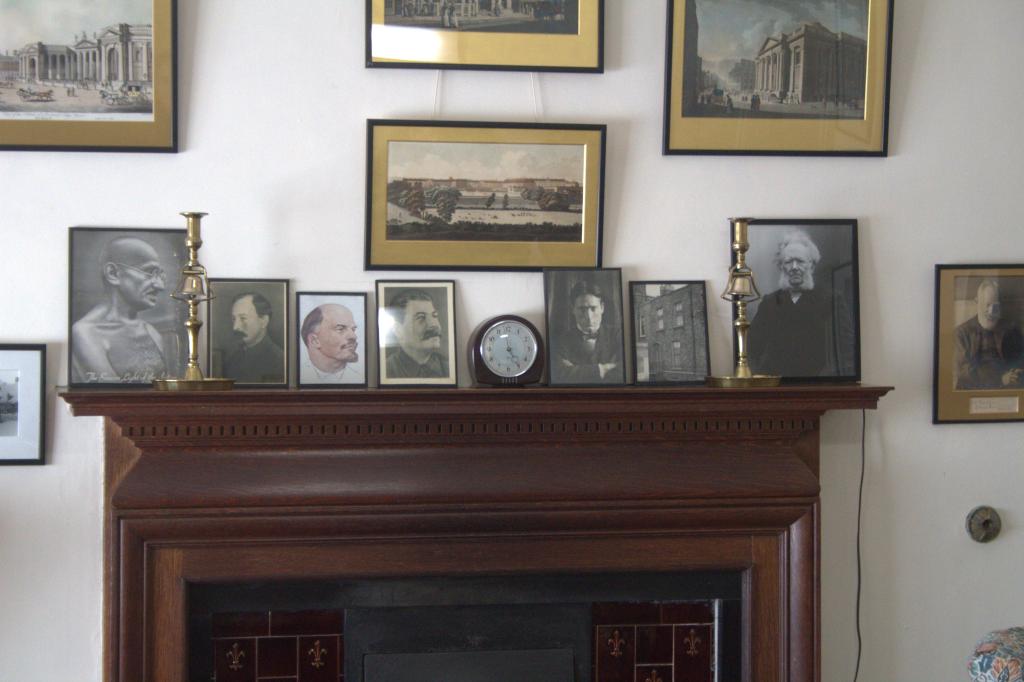
Shaw’s Wall of Portraits

While the gardens are lovely, it was the inside of the house that I found the most interesting. For the most part it is fairly unspectacular, a big green door opens into a room with off-white walls and framed photos and paintings surround another clutter of off-white doorways that lead to more rooms. The furniture is frail, the decoration old-fashioned with gaudy flower patterns adorning the greenish-white curtains. But one particular decoration really hadn’t aged well. Along the top of one fireplace was a row of photos and drawings: first I noticed a photo of Gandhi… then Lenin, then Stalin. It turns out that Shaw was a dedicated socialist, eugenics enthusiast, dictator admirer and crackpot who thought Hitler should be allowed to escape retribution after WWII and retire to a quiet life in Ireland. It made the old curtains seem positively progressive.

A view of Shaw’s Corner from the gardens

Up the stairs, in the former room of Shaw’s wife Charlotte, was the ‘museum room’. On the wall were flowery quotes and extracts from letters, written by Bernard Shaw. Unfortunately for Charlotte, the letters were not addressed to her but to one “Mrs Pat”. Mrs Patrick Campbell, an actress and socialite, was inspiration for many of Shaw’s characters and, once they began negotiating her appearance as Eliza Doolittle in Pygmalion, the two began an intense relationship and exchange of passionate letters. Although Wikipedia tells me it was an ‘unconsummated’ relationship, I’m sure Shaw’s obsessive gushing didn’t please his wife.
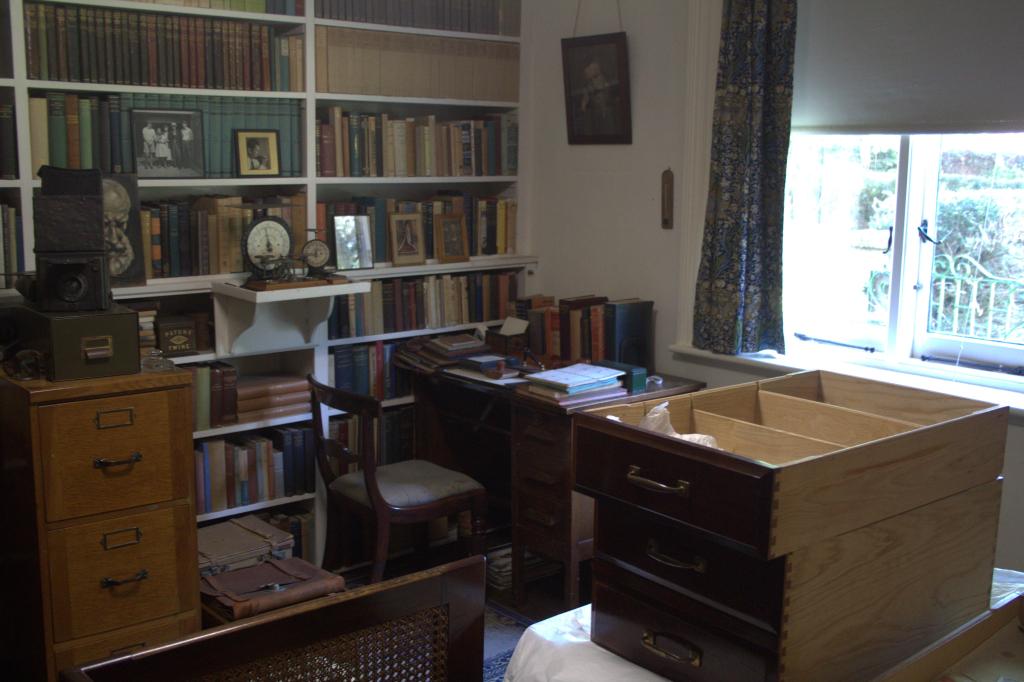
A room full of books in Shaw’s Corner

The whole thing reminded me of Thomas Hardy who developed similar infatuations with female acquaintances. Florence Henniker, a writer with whom Hardy eventually collaborated, was forced to reject his romantic advances (despite his being married at the time), although was later used as inspiration for Sue in his final novel Jude the Obscure.

Later in life, the actress Gertrude Bugler became an object of interest for the now eighty-year-old Hardy as she played the leading roles in the stage adaptations of many of his novels. This time, when Gertrude was due to star in Tess of the D’Urbervilles in London, Hardy’s second wife gave in to her jealousy and refused to allow it. While I don’t have Thomas Hardy posters on my wall or drift off to sleep listening to his poetry, it leaves a slightly bitter taste when someone who’s work you admire has their raw, unfiltered character revealed to you.

All this made me think of how we deal with the complexity of our cultural heroes. George Bernard Shaw is undoubtedly significant, his work should be read and not thrown out along with his troubling personal philosophies. I am glad that the photo of Stalin remains on the fireplace as a record of Shaw’s reality, but it seems to be just an inconvenient footnote attached to a monument to his brilliance. And I concede that the house may exist as just a snapshot of a famous person’s life for posterity but the National Trust website just delivers a watered down version of Shaw’s socialism that feels a bit intellectually insincere; a way to justify the celebration of the man. But it has to be possible for people to exist both as venerated celebrity and flawed human.
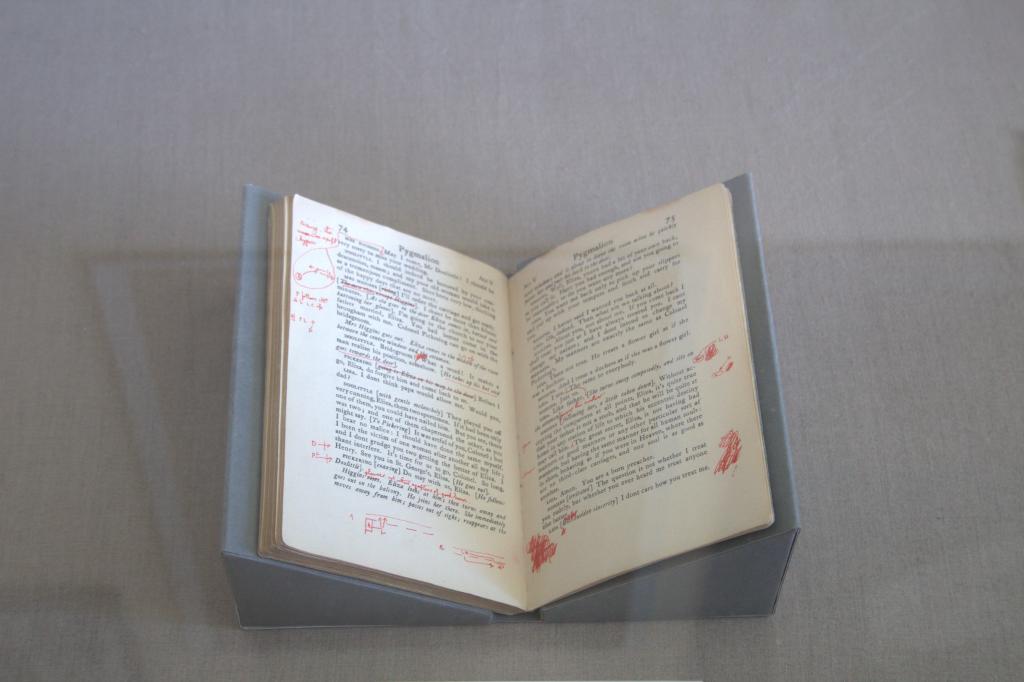
An annotated manuscript

In the social media-influenced dialogue, however, it seems that there is a shrinking space for complexity and nuance. I think ‘Cancel Culture’, perhaps rather controversially, can be a useful phenomenon… sometimes. When a public figure’s reputation is so concretely positive and elevated, it can take a collective effort to pierce the facade of perfection. But, in a sphere where everyone craves clickable, shareable and digestible opinions, people must be heroes or villains– and the distance between those two states seems to be shrinking.

In the current climate, this piece could be considered a concrete cancellation of George Bernard Shaw, and the National Trust’s literary hero becomes a villain. But I think really it is just unveiling another aspect of a messy, human life and, while it takes more effort to untangle appreciation for achievements from dogma and ideology, it makes for a far more interesting story. Surely Winston Churchill can be both a white supremacist and unalterable enmeshed with the story of Allied victory in WWII and any complete deification or vilification is unhelpful. But perhaps those who were made victims at his hands would rightly call out my insistence on balance and nuance.
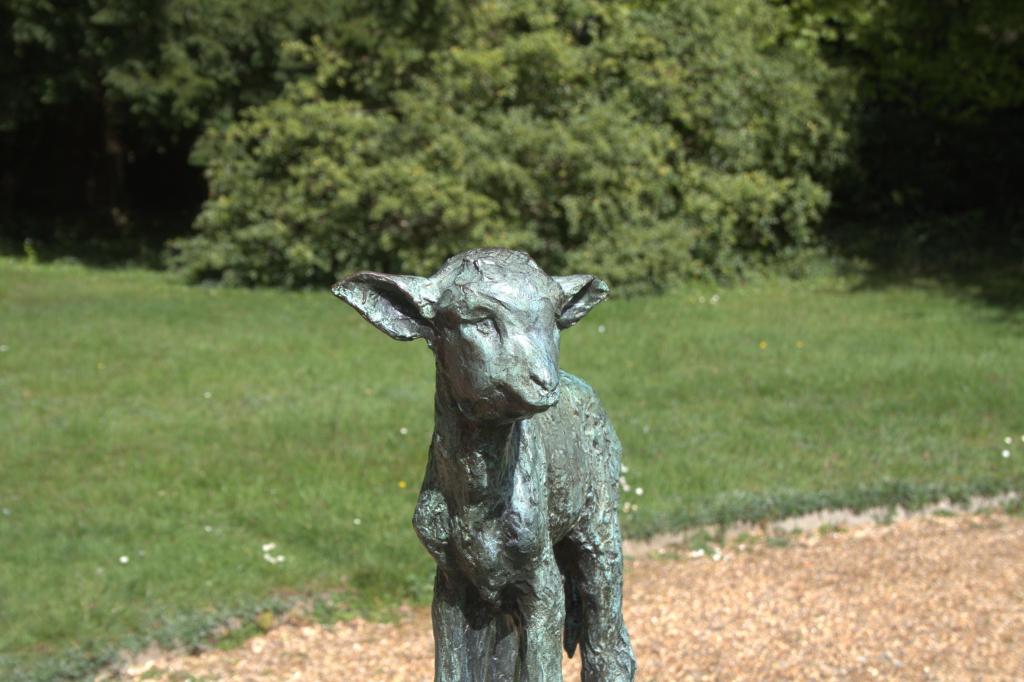
A statue in the gardens at Shaw’s Corner

I don’t know what the right answer is but what I have decided for myself is that not only should you not meet your heroes, you shouldn’t make them in the first place. And as we were leaving Shaw’s Corner, we went up to the silver food truck and bought a couple of drinks. While the girl was grabbing them she told us about Shaw’s office in the gardens outside the house. ‘It rotates so he could face the sun whenever he wanted, ‘ she told us, ‘and he called it London, so his housekeeper could tell unwanted guests that he was away in the capital’. I chuckled thinking about the clever system and decided perhaps one should not meet their villains, either.
Wimpole Hall: Books, Big Baths and Mrs Bambridge’s relics

At about 1pm on a lazy Sunday we decided to head to Wimpole Hall. The estate is in the village of Wimpole, just outside of Cambridge, and on the 45-minute journey we drove through sleepy retirement communities, passing signs for whimsical places like Litlington and Bassingbourn-cum-Kneesworth (seriously). As we approached the estate a small sign told us that the Estate was ‘full’, which was slightly concerning. But while it was not, in fact, full it was what I described as bloody busy. We circled the car park a few times to no avail before waiting in the ‘overflow carpark’ (a big field) for a space to become free. It was the first genuinely sunny days of the year which was the impetus for our trip but it also meant that, with the upcoming half-term, the vast grounds were filled with middle-class families complete with long-haired children and Hunter wellies.

The Old Stable Block

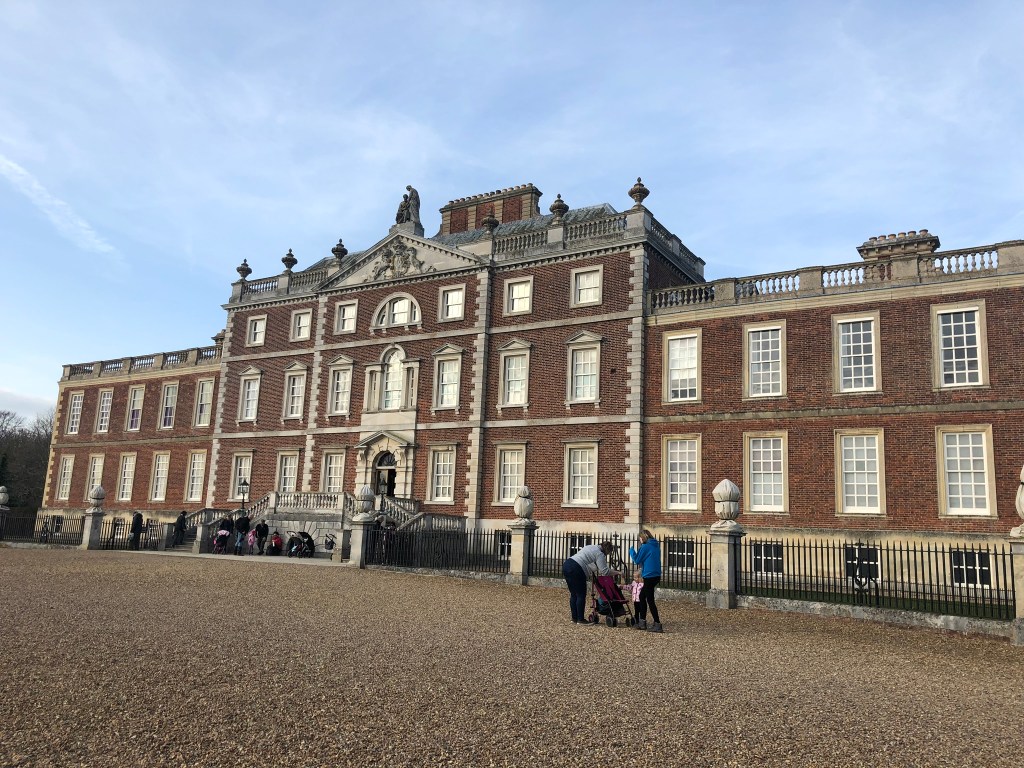
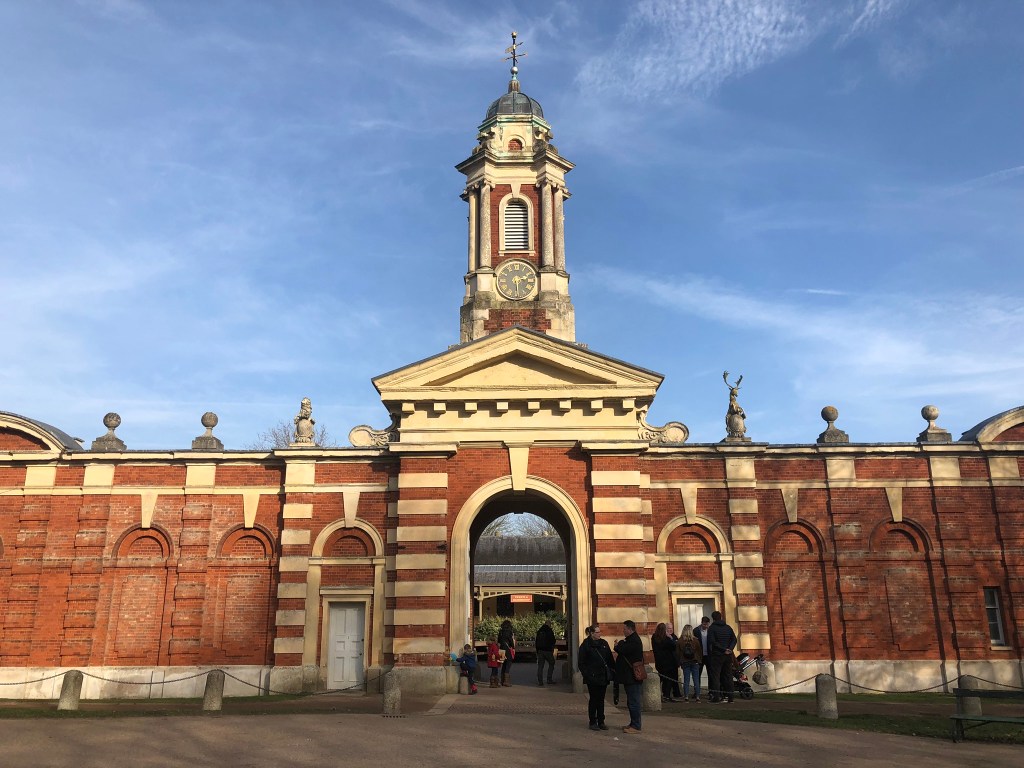
On the way to the hall you pass the old stable block– now a courtyard set inside four walls of bright red brick, the entry way topped with a narrow clock tower, finished with white columns and a flimsy weather vane. Further up the path there is a church, made a bit less welcoming to visitors by its placement behind a row of bushes and black, metal fence. This, too, displays the beautiful red bricks on about four fifths of its exterior, the rest is made up of large beige blocks betraying the combination of old and new structures. “A Frankenchurch” I said out loud, met by an entirely deserved silence on the still air. Finally, after rounding a slight corner, you reach the hall. Again, the red brick is on display, interrupted by dozens of windows which are accented by dirty white borders. But the most striking thing about the hall is its unfaltering, incredibly satisfying, symmetry. Three tall rectangles with ornaments dotted along the roof, flanked either side by a slightly shorter pair of rectangles.

Latin Quote Set in Stone.

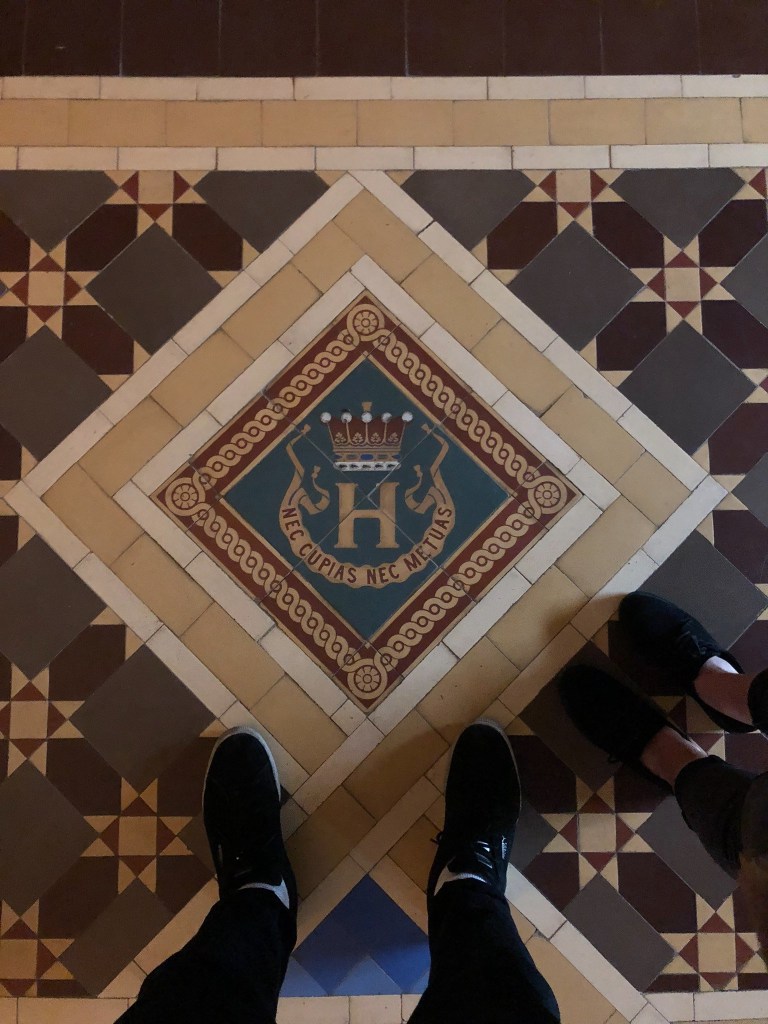
We stopped briefly to take some photos before heading up the gravel path and inside. The first room you step into is pretty ostentatious, with faux marble pillars and Latin quotes, quite literally, set in stone underfoot. ‘Nec Cupias Nec Metuas‘– neither desire nor fear, to want for nothing and to fear nothing as Google reliably informs me. These extravagances, along with bright white busts that sit below murky paintings of a dog and horse, made this room the most typically ‘country estate’ and the least homely. But as you move further into the house a strange combination of antiquated extravagance and the ordinary becomes apparent. The hall was passed from Sirs, to Earls, to Dukes, Lady’s and Viscounts before ending up with Elsie Bambridge, daughter of writer Rudyard Kipling. And until 1976, the year she passed and bestowed the house to the National Trust, Elsie remained.

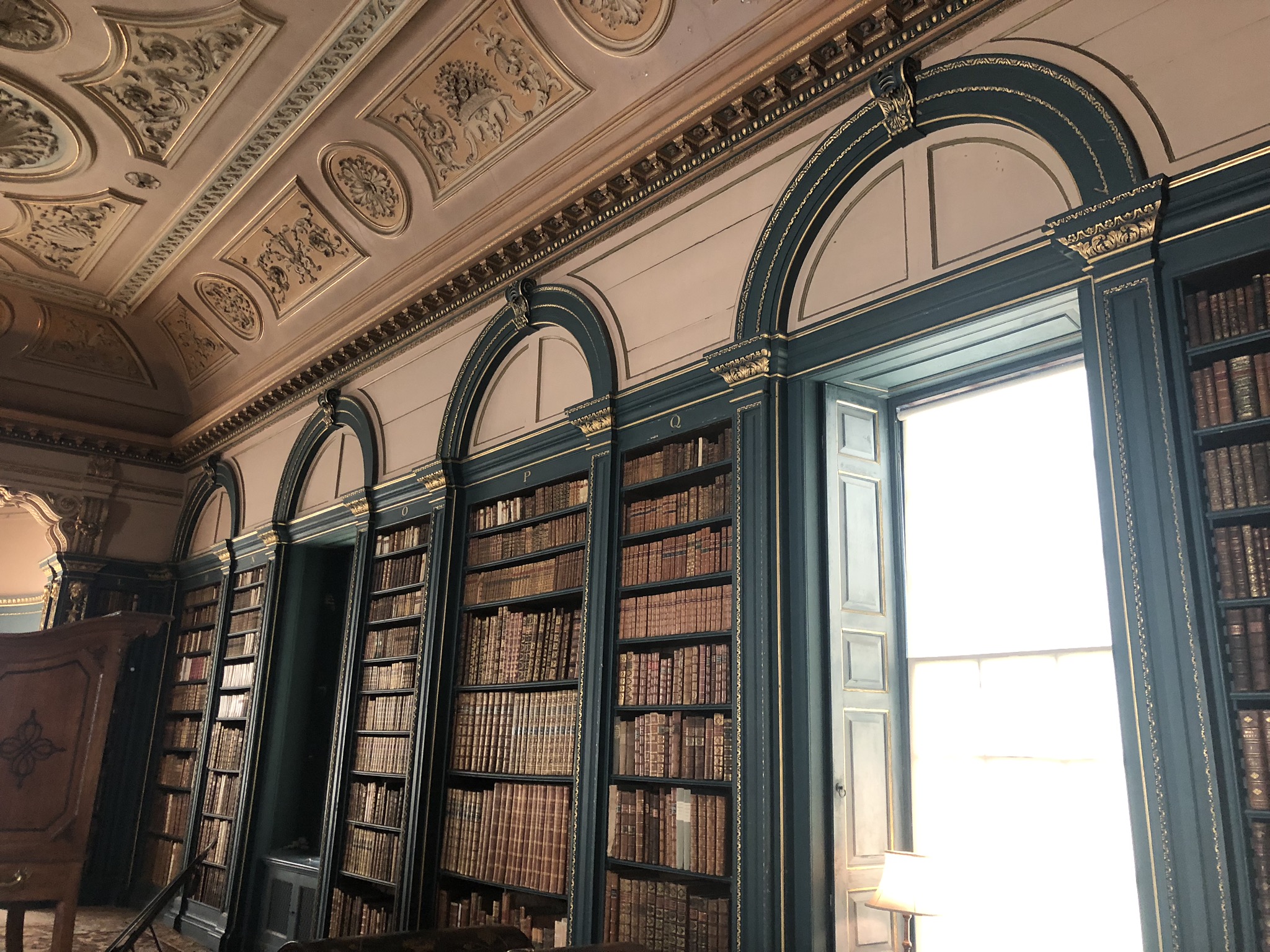
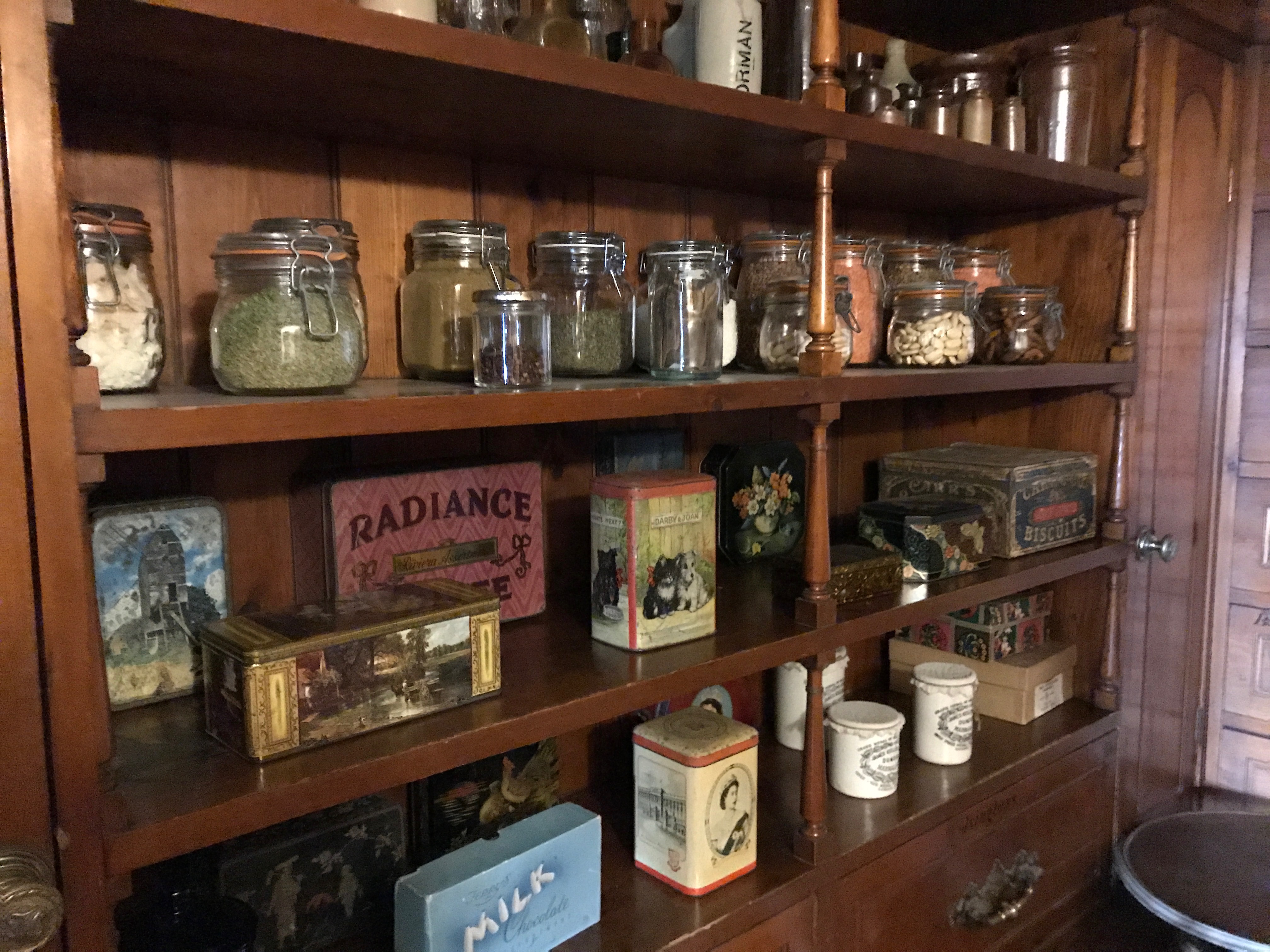
As I mentioned before, the house definitely has its indulgences and excesses. There is a huge bath in which the whole village could probably bathe, a magnificent library with thousands of leather spines on display (which, as a hoarder of books, made me extremely jealous), not to mention a private chapel and a space, the size of some people’s flats, that remained relatively empty because the owners couldn’t decide what to do with it. But as we wandered around the hall, the things that constantly caught my attention were the remnants of an old lady’s life who lived not too long ago, an uncannily familiar world that is just slightly out of reach. In the pantry, for example, was an old Terry’s Milk Chocolate packet that must have been from about 40 years ago which made me imagine Mrs Bambridge indulging in her favourite sweets on a winter evening. Also, despite the seeming grandeur of the paintings hung on the walls, they expressed a sense of humour and humanity. Firstly, if you’re looking for paintings of animals then Wimpole Hall is the place to go– it seemed that every other painting had a majestic horse posed in its foreground or at the very least a dog placed at the feet of its owner. But, one painting in particular stood out as highlighting the levity with which Mrs Bambridge treated her decoration. Lit from below by the painfully yellow glow of a dusty lamp, there hangs the portrait of a cartoonish, young woman cradling a green bottle in her left hand and raising a glass in her right– cork unscrewed on her lap, eyelids heavy and mouth shaped into a playful smile.

In many cabinets there were these small porcelain figurines– so delicate looking and painstakingly decorated with watery colour– that reminded me of something my grandmother used to own. She had this snowy white figure of a woman, accented with sky blue, and she was holding an umbrella that you could remove (though I don’t think we were supposed to). In fact, the most overwhelming part of the experience was the smell. It smelt like my grandmother’s house. The floors creaked like her floors would creak under the same thin carpet. Jess said the pantry smelt like her grandmother’s kitchen– the musty glow of spices kept for decades, trapped in the old wood. All this made the hall feel familiar, lived in, real and with the fingerprints of a real woman all over it. A man in the basement of the house told us about a radio that still had the old names of stations on it and how he would listen to Radio Luxembourg because that played pop music. Another told us about the hall’s late adoption of electricity, lacking it even when she was a young adult in the 60s. While other historic buildings and sites can feel cold, all this gave Wimpole a distinct vitality. Its story felt tantalisingly close– in reach– as though if you tried hard enough you could step back there and live it, Mrs Bambridge having just popped out for tea.

Wimpole Hall

Lately I find recent history more and more fascinating. Partly nostalgia and sentimentality but also partly, I think, because it is easier to discover and imagine the human aspect in those stories– the minutiae of experience. I heard in a video someone use the term ‘relics of humanity’ to describe the clues of previous owners found within or attached to second-hand purchases they made on eBay and I think that phrase sums up the main reason I felt enamoured by Wimpole Hall. After the long line of aristocratic owners, the hall ended up in the (relatively!) ordinary hands of Elsie Bambridge. And behind her, in a house full of excess, she too left her own relics of humanity, the things that cut through and resonate beyond the conceits of a stately home and remind you that these people existed not in the abstract of a booklets and plaques but in the same world of joy, pain, loss and love that we do. Their voices still seem to ring around the rooms, the beds seem still warm.