The Memorials of Glasgow

A few weeks ago I went to Glasgow.

On our first day we walked to the Kelvingrove Art Gallery and Museum, pushing through a grey morning in a city that wore it like an old jumper as the rain flickered happily in the air.
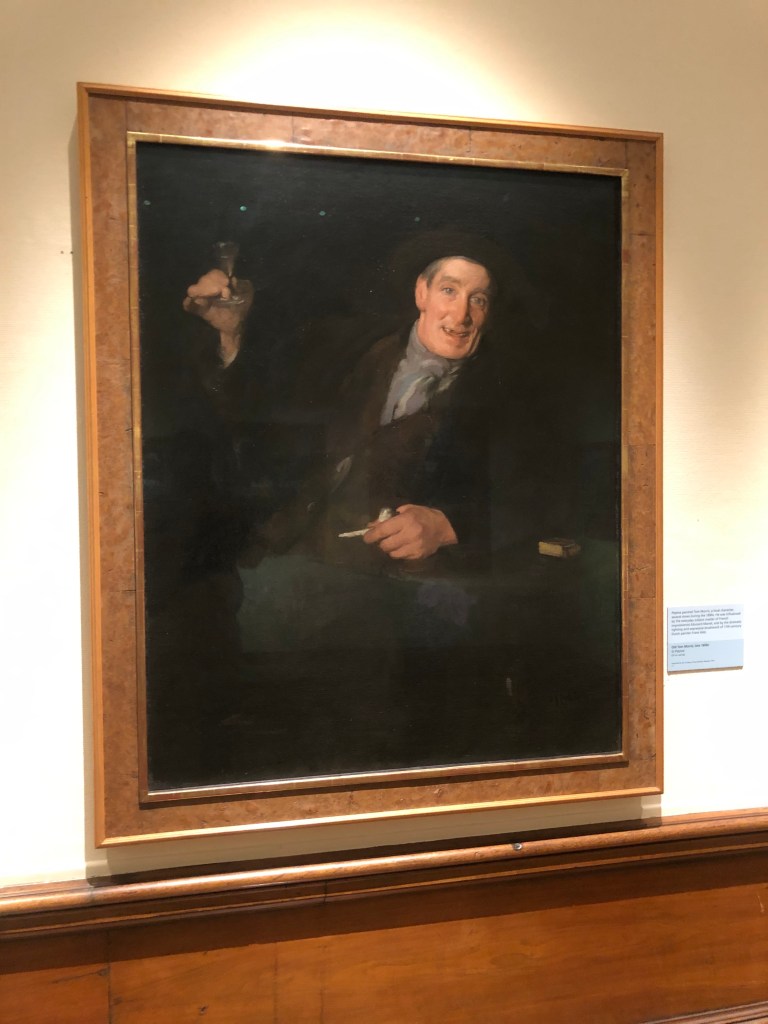
“Old Tom Morris” by S. J. Peploe

I’d never heard of the Glasgow Boys– a group of anti-establishment painters, active in the late 1800s– but an exhibition of their work provided me with a whistle stop tour. Many of the pieces felt tailor made for a sentimental softie such as myself, with sensitive evocations of impossible rural scenes, whispered on to the canvases. They made me think of Thomas Hardy, another favourite of mine who conjured up an imagined past and set about defending it from corruption with vigour.

But the painting that struck me the most was not an idyllic landscape but a portrait. Emerging from a dark sea of paint, that barely hints at a room, is the bright face of Old Tom Morris, who leans on a wooden table and raises a dainty glass to us. The placard tells us that Tom Morris is a ‘local character’ who the artist, S.J. Peploe, painted multiple times. I think the term local character is brilliantly provocative– it animates the mischief and vitality that Peploe had encased in Tom’s frozen expression.

I think the incredible lightness of his portrayal is not only an attempt to reflect his nature but also a philosophical point being made by the artist. Tom represents the veracity of (then-) modern life that fascinated and inspired many of the Glasgow Boys and he is presented as the antidote to the artifice of academic painting of the time. In the wake of his smile, we feel the warmth of chatter down the local and the joy of our friends’ idiosyncrasies. It is a memorial not only to Old Tom Morris, but to the weightlessness afforded by sincerity and the sharp crunch of gravel on the walk home.

With this in mind, as I walked away from Tom’s radiance, I was reminded of a more recent phenomenon that seeks out an unfiltered reality. On TikTok and YouTube and Instagram there are thousands of videos of people featuring ‘ordinary’, often vulnerable, individuals as the basis of their content. Most recently, I have seen videos of street photographers approaching homeless people to take their portrait.

On the one hand, it can seem fairly harmless, or even positive. We can cut through the sanctimonious, hateful bullshit of the media and the widespread ignorance of the social internet and be placed face-(to-screen)-to-face with a person, rather than a contrived and deliberately divisive caricature. They are made real for those who might otherwise dismiss them as an inconvenient and distant artefact. Their humanity is insisted upon and their dehumanisation made much harder– though some people, no doubt, continue to try their best.

But they also become an object for the creator and a tool that ultimately tells a story that they have no control over; a convenience, a fable. A lot of the time accompanying captions and comments show just how easily the individual can sink below the surface of platitudes and life lessons like ‘never judge a book…’ and ‘we are all one human race’. Is it really imbuing someone with dignity to broadcast their life for another’s gain, even if it is under the guise of ‘art’ or ‘creation’? Sometime the artists themselves can see their intended narrative spiral out of control.

An even more contentious version of the same phenomenon is the filming of homeless people being given money or food by the creator. Again, it can be useful to highlight good deeds and humanise a marginalised group, but can we truly be comfortable as an unsuspecting bystander is immortalised, and consumed into a memorial to the harsh realities of our society.
Granted, the question of how Old Tom Morris would feel about being painted if he had know he would be hanging on the walls of the Kelvingrove as a kind of zany embodiment of provincial life seems a bit inconsequential. But for the modern subjects, who are captured in the much more immediate mediums of photography and video, it seems like a very pertinent consideration to make.

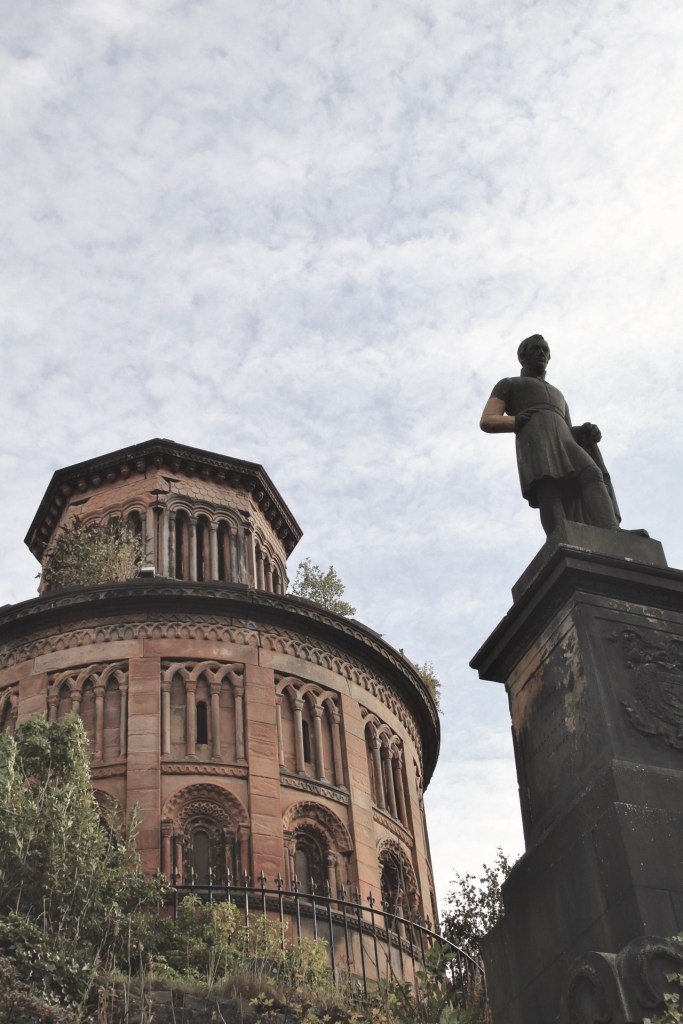
The next day we went to see some more literal memorials. The Glasgow Necropolis is a strange place, if I’m honest. The paths wind breathlessly up a hill, lined with dull stones in a multitude of greys. This is the antithesis of Old Tom Morris saluting the passing museum guests. This is a performance, a most silent and still song and dance.

See the tallest column and largest name and think of me, not as I was or ever could be.
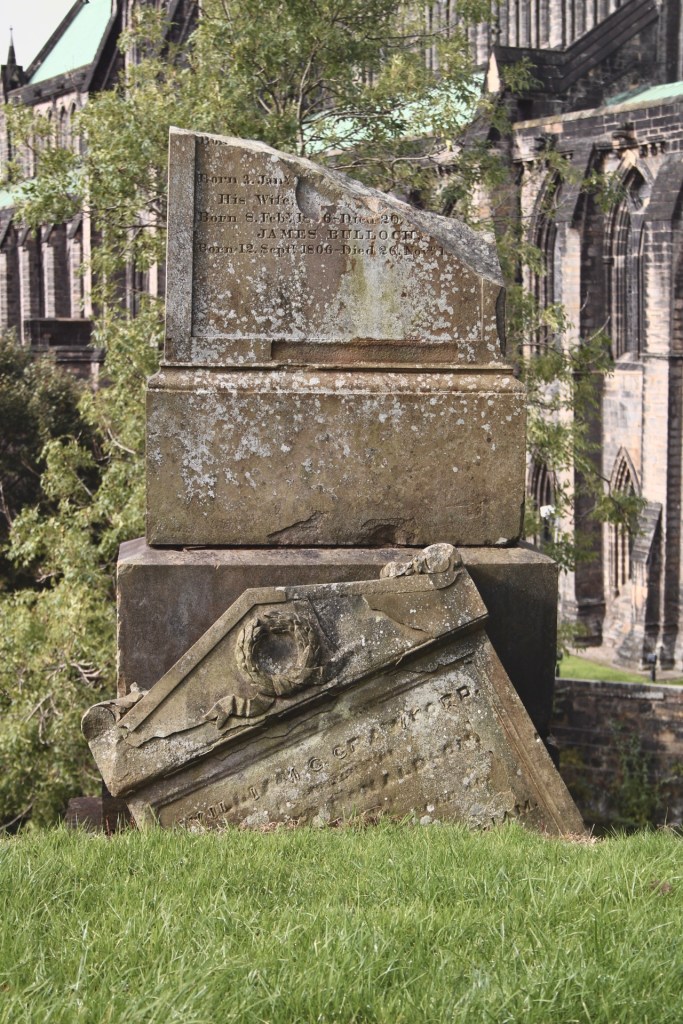
There is no truth to discover, really, because we’re forced to accept their story as it is carved before us. The cloud of sorrow barely dampens the shrill ring of wealth that echoes around the extravagant tombs and statues. But the artifice is also fragile. Another group walks a few feet behind us and laughs at some apparent contradiction chiseled into the stone. Like our painting in reverse, the humanity seeps through the facade. Suddenly the desperation is all around, the human tragedy of monuments built to assert the agency of the dead makes the faces of statues cry.

Memorials are for the living, and those who once lived. More is revealed in the way we react to them than to the things themselves or, obviously, by the people and things they memorialise. Each sacred thing takes a piece of each person who spends a while with it, and that is it’s power.

As we left and headed down toward the cathedral, we walked past a headstone torn in half down the middle like Styrofoam. I felt the sting of sadness and shook my head, as though for them but really for me.

Ultimately, we end up as the interpretations of those we surround ourselves with and those who choose to surround us. It is empowering and debilitating all at once but the contradiction persists at a kind of equilibrium. We should give care to our interpretations, and be sceptical of the lenses through which others are portrayed.

From a crowded wall at Kelvingrove

Old Tom Morris beams

Towards the muted audience

Those eyes seem glad to see.

“Here you see the everyman

I’ve caught and brought to view.

The meting of his dignity

I will entrust to you.”

This is Old Tom’s legacy:

One thump of beating heart.

So, did he know the consequence

Of this shallow part

You wrote for him, then silenced

His laugh with tender strokes,

And turned his face to playing ground

For reflection-seeking folks.

That is not Tom Morris,

Who’s collapsing into view.

Tom just holds a mirror up

And takes a piece of you.
Where Our Compassion Sits

Some days there are those gusts of gloom,

Laced with the nagging smell of grief,

Which gathers clouds with gnashing teeth

That darken each uncrowded room.

Down the sheets of dark descend

To stun outstretched, unshaken hand.

Quick– slam the doors to neighbours’ land

And chill the warm embrace of friends.

Some days you ask the darkness in

Through the anxious scrolling thumb.

The graver news that always comes

weighs on your soul, deep under skin.

But kindled there, the fire of hope

That punches holes in sheeted dark.

It’s sparked by aching, beating hearts

And fanned by hands of bathroom soap.

Though it’s no war; Dunkirk nor Blitz,

We fight these battles where we can.

But let’s give one empty, peaceful hand

To grow where our compassion sits.

Shaw’s Corner: A Lesson in Not Meeting Heroes

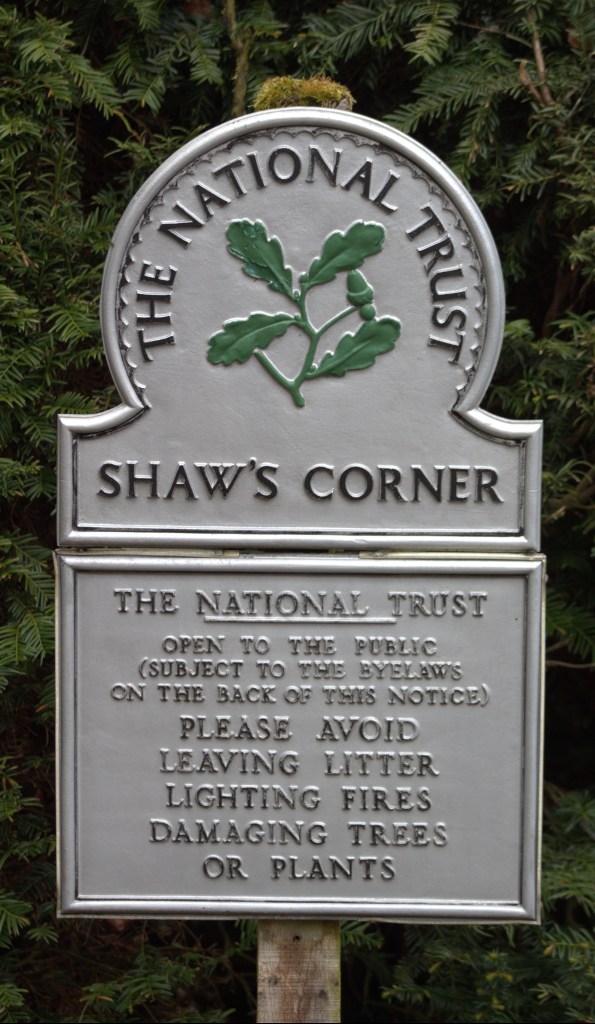
The other day I went to Shaw’s Corner. The former residence of Irish playwright George Bernard Shaw; or GBS to his friends (not really). Now I didn’t really know anything about Shaw: I came across him in passing during my undergrad, I knew he wrote Pygmalion, which was adapted into My Fair Lady, but almost nothing else. I was only there because of its proximity to me and my need to try out a new camera, so I went in with an open mind. The house is quite remote, at the end of a series of long, empty roads with blind corners, lined with thick bushes and trees– the fair weather made the journey feel like a summer road trip . You arrive first in the car park, with dusty, crunchy gravel underfoot, a silver food truck and a hut housing all the Bernard Shaw-themed merchandise you could want.

We walked in to the hut and scan our membership cards and left feeling very smug and self-satsfied after being congratulated for having young person’s memberships (for we are the vibrant, promising future of the National Trust). The house itself is obscured by tall hedges along one side of the car park, but once they are rounded the house pops into view. It’s an odd sight. The walls, a reddish-brown brick accented with bright green pipes and window frames, seem to jut out at random and three rooftop chimneys complete its unusual silhouette. It feels like something out of The Hobbit or a Wordsworth poem, the greenery that clings to so much of the walls make it seem like the house itself might have sprouted from the ground.

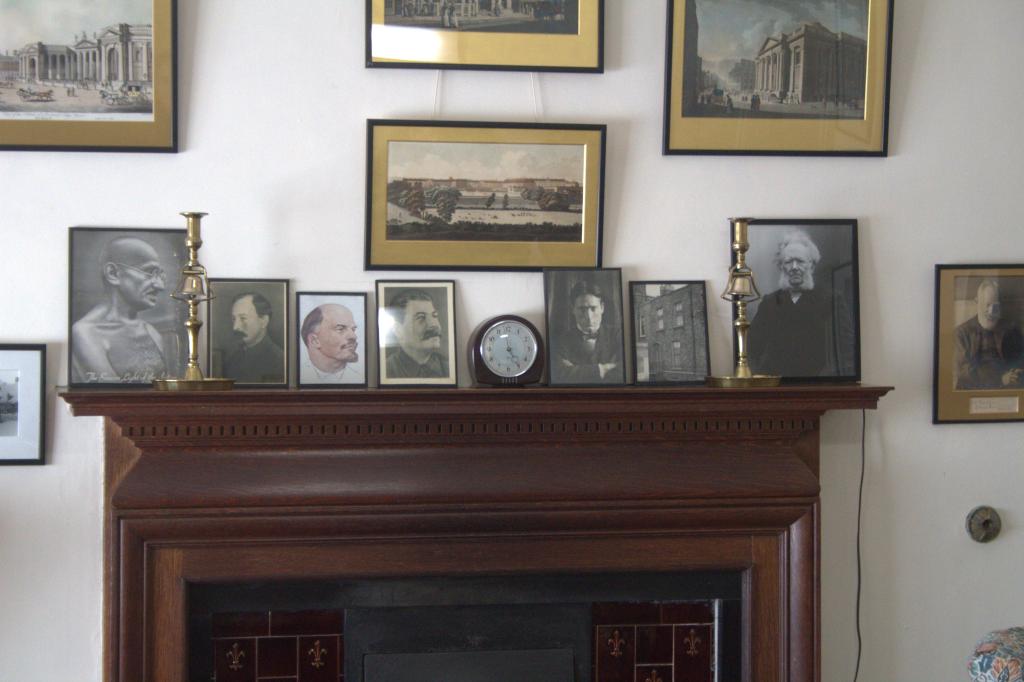
Shaw’s Wall of Portraits

While the gardens are lovely, it was the inside of the house that I found the most interesting. For the most part it is fairly unspectacular, a big green door opens into a room with off-white walls and framed photos and paintings surround another clutter of off-white doorways that lead to more rooms. The furniture is frail, the decoration old-fashioned with gaudy flower patterns adorning the greenish-white curtains. But one particular decoration really hadn’t aged well. Along the top of one fireplace was a row of photos and drawings: first I noticed a photo of Gandhi… then Lenin, then Stalin. It turns out that Shaw was a dedicated socialist, eugenics enthusiast, dictator admirer and crackpot who thought Hitler should be allowed to escape retribution after WWII and retire to a quiet life in Ireland. It made the old curtains seem positively progressive.

A view of Shaw’s Corner from the gardens

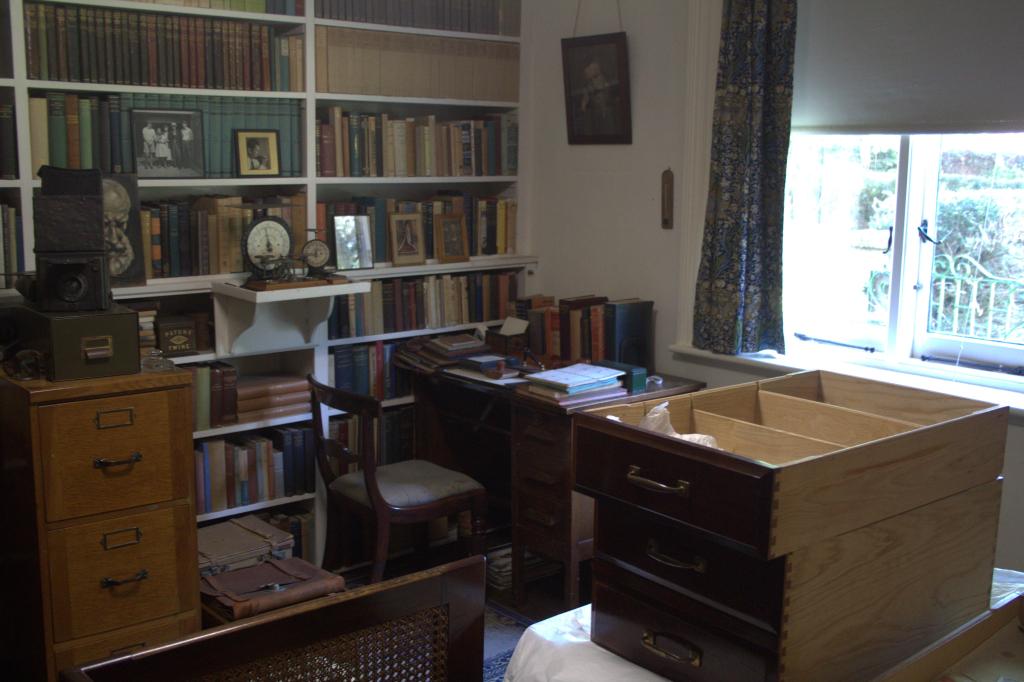
Up the stairs, in the former room of Shaw’s wife Charlotte, was the ‘museum room’. On the wall were flowery quotes and extracts from letters, written by Bernard Shaw. Unfortunately for Charlotte, the letters were not addressed to her but to one “Mrs Pat”. Mrs Patrick Campbell, an actress and socialite, was inspiration for many of Shaw’s characters and, once they began negotiating her appearance as Eliza Doolittle in Pygmalion, the two began an intense relationship and exchange of passionate letters. Although Wikipedia tells me it was an ‘unconsummated’ relationship, I’m sure Shaw’s obsessive gushing didn’t please his wife.

A room full of books in Shaw’s Corner

The whole thing reminded me of Thomas Hardy who developed similar infatuations with female acquaintances. Florence Henniker, a writer with whom Hardy eventually collaborated, was forced to reject his romantic advances (despite his being married at the time), although was later used as inspiration for Sue in his final novel Jude the Obscure.

Later in life, the actress Gertrude Bugler became an object of interest for the now eighty-year-old Hardy as she played the leading roles in the stage adaptations of many of his novels. This time, when Gertrude was due to star in Tess of the D’Urbervilles in London, Hardy’s second wife gave in to her jealousy and refused to allow it. While I don’t have Thomas Hardy posters on my wall or drift off to sleep listening to his poetry, it leaves a slightly bitter taste when someone who’s work you admire has their raw, unfiltered character revealed to you.

All this made me think of how we deal with the complexity of our cultural heroes. George Bernard Shaw is undoubtedly significant, his work should be read and not thrown out along with his troubling personal philosophies. I am glad that the photo of Stalin remains on the fireplace as a record of Shaw’s reality, but it seems to be just an inconvenient footnote attached to a monument to his brilliance. And I concede that the house may exist as just a snapshot of a famous person’s life for posterity but the National Trust website just delivers a watered down version of Shaw’s socialism that feels a bit intellectually insincere; a way to justify the celebration of the man. But it has to be possible for people to exist both as venerated celebrity and flawed human.

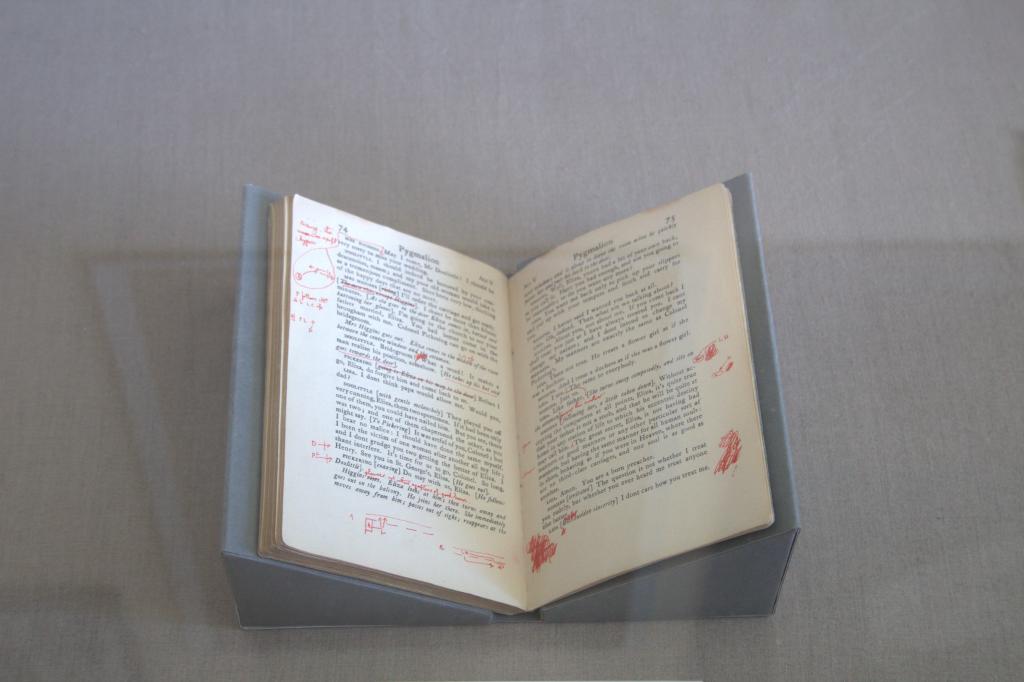
An annotated manuscript

In the social media-influenced dialogue, however, it seems that there is a shrinking space for complexity and nuance. I think ‘Cancel Culture’, perhaps rather controversially, can be a useful phenomenon… sometimes. When a public figure’s reputation is so concretely positive and elevated, it can take a collective effort to pierce the facade of perfection. But, in a sphere where everyone craves clickable, shareable and digestible opinions, people must be heroes or villains– and the distance between those two states seems to be shrinking.

In the current climate, this piece could be considered a concrete cancellation of George Bernard Shaw, and the National Trust’s literary hero becomes a villain. But I think really it is just unveiling another aspect of a messy, human life and, while it takes more effort to untangle appreciation for achievements from dogma and ideology, it makes for a far more interesting story. Surely Winston Churchill can be both a white supremacist and unalterable enmeshed with the story of Allied victory in WWII and any complete deification or vilification is unhelpful. But perhaps those who were made victims at his hands would rightly call out my insistence on balance and nuance.

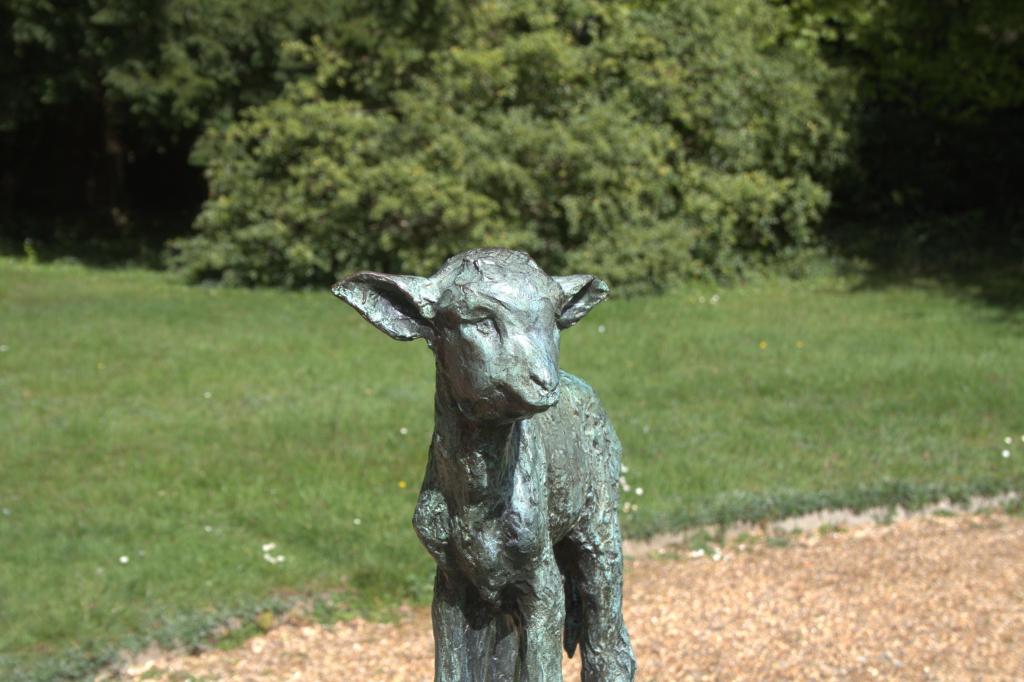
A statue in the gardens at Shaw’s Corner

I don’t know what the right answer is but what I have decided for myself is that not only should you not meet your heroes, you shouldn’t make them in the first place. And as we were leaving Shaw’s Corner, we went up to the silver food truck and bought a couple of drinks. While the girl was grabbing them she told us about Shaw’s office in the gardens outside the house. ‘It rotates so he could face the sun whenever he wanted, ‘ she told us, ‘and he called it London, so his housekeeper could tell unwanted guests that he was away in the capital’. I chuckled thinking about the clever system and decided perhaps one should not meet their villains, either.