Luton, from above

The second best thing

About living near an airport—

Behind the short walks home

In the familiar squeeze

Of a drizzling English evening—

Is the takeoffs in late spring.

Tearing away gently from solid

Ground and over familiar trees,

As glimpses of a past life

Flicker in eyes by the window seats.

Higher still, you see the stretch

That once seemed like a universe.

A collection of toy houses

Tethered together by memory—

But too far to see clearly, now.

But still the matchstick figures

Press on as we sail from view,

And the sun beats a parochial beat.

I spot, then, where we cut our shape

In the thin, gold film and cast a shadow

On the hallowed ground:

Briefly and lightly,

Just like life below.
things change

things change

sometimes you are borne away

on the mild tide of social entropy

and other times you’re split apart

in a searing flash like nuclear fission.

things change

and despite my hoarding tendencies

i know we can’t spend our time

arranging people on our shelves—

instead we are left to decorate

with memories in quiet rooms.

things change

but we should be kind to ourselves

to ease the very next heartbeat

because while those words fill our eyes

and scorch the earth of the past

they also cast the shadow of a promise:

things change

The Wedding

There were no church bells on the day,

Save for the sound of muffled chimes

From the nearby parish clock.

Instead the balmy summer air

Rang with the sound of a union:

The faith of this one-time congregation.

The flies and wasps duly rise,

Made milder, somehow, by conversation

That blooms in the haze of acquaintance.

Then I watch as childhood friends,

Who glow amongst the average folk,

Transcend beyond our younger days.

Softer faces smile beneath the suit

Of grown-upness, tried on,

And slowly filled as they share

Their promises, with gutsy sincerity.

Then the shameless egoist in me

Is warmed by the fleeting thought

That they sail away with some piece of us

That echos in an idle reminiscence

As tender interludes to their forever.

I saw you

I saw you kissing him

At the regional marketing awards.

You were taken by his joke

About declining email open rates

In the sector.

You arranged a sincere congratulations

About his third-place award,

And slid it under the door of irony:

That we had all paid to be there

And to enter.

You were pleased to see he’d worn

His branded Ben Sherman socks—

Revealed below his trouser cuff

As he fished in his pocket for something:

Excuses to talk.

Later, you’ll forget the sweet picture,

Clumsily framed on screen, of his kids—

Illuminating both of your faces briefly,

Like the harsh dawn of reality

For nighthawks.

But all you’ll feel, lost in the universe

Of Premier Inn sheets, is the coolness

Of his wedding ring on your forearm,

As he sang with the band, to the tune

Of fleeting possibility.

It’s okay

It’s okay, isn’t it, that we don’t mean

The same to each other? And does it really

Hurt that you’re something of a token for

A time, you may not even mark as important?

Because I don’t expect you to remember

When you read “Adlestrop”— your voice,

Above autumn weather, like a summer day:

Longed for and then slowly blown in.

And that faint impression of you is a part

Of a feeling now: the one that will arrive on

Quaint train platforms, or when I think of

The days kept for the scared and sentimental.

Then, when chance closes that useful rift,

You have the grace to nod in knowing recollection

When I bring it up to you. And, with mercy,

You say little more— a final gift to me.

They’re taking Wilfred Owen off the syllabus.

They’re taking Wilfred Owen off the syllabus,

And really I shouldn’t care. Our boy’s legacy

Will persist in spite of some administrators,

Tinkering at the edge of teenage education.

And besides, he won’t miss the sickly nostalgia

For words grifters might have read but never understood.

This final death of the writer; as ghostly lines

Erupt in pubs— an engine revved by the Daily Mail.

But I can’t help feel a childish kind of loss.

Protective of enchanted objects handed down

To that boy I’ll never be again, given credit

For spinning facile meanings, while sheltered from truth.

Now, past his tender age, I find no faith in facts.

And those words— just as when they stomped with unknown pain—

Remain lost on me, obscured in the haze of youth:

Doomed to the glow of the past, where we still warm our hands.

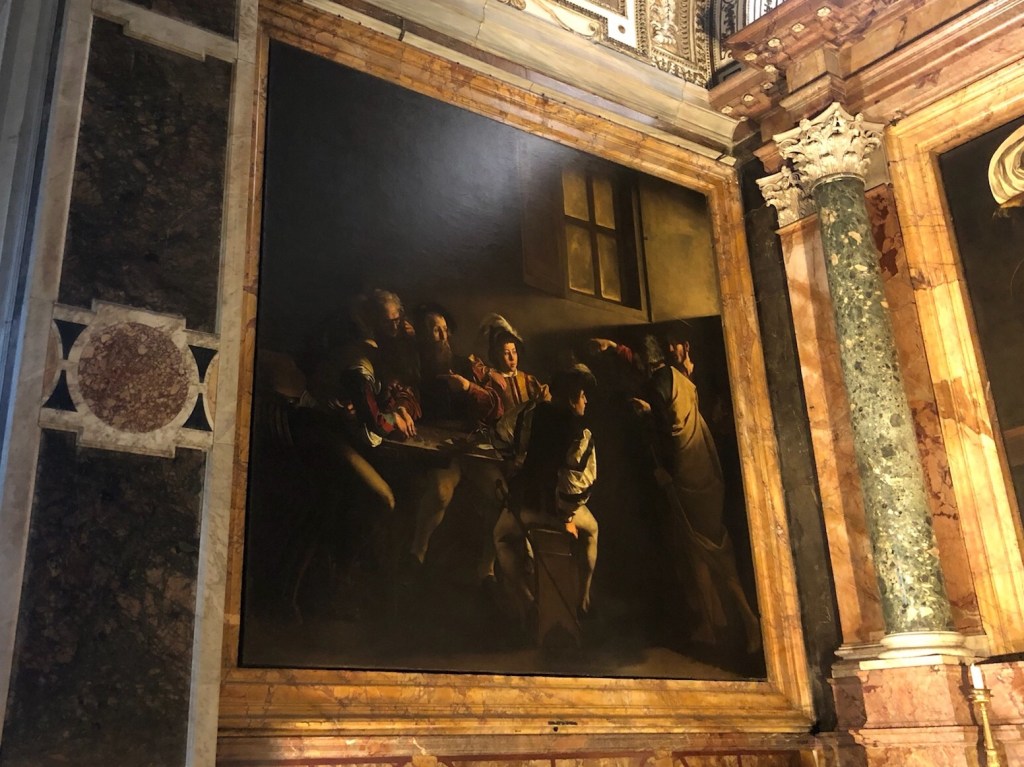
The Calling

It could be the way it looms, stately, over you,

Revealed suddenly on the hidden left hand wall,

Of the left hand chapel, made quietly immortal,

For that forgotten French cardinal in Rome.

Or maybe it’s this desperate space in between,

Where tender strokes dissolve into reality,

And the souls of saints are found– set free

From the soft, half-lit faces of old friends.

And yet for me, Matthew’s unsure hand is mine,

And the divine light hums today’s same evening tones,

And the tender hand of Christ is the artist’s own,

Reaching out, across mundanity, towards this disciple.

The Grand Hotel

Will you think of me at The Grand Hotel?

A room paid in full— with a handsome tip,

Deftly slipped into the hands of the valet.

Will you take the time to wait for me,

Just around the final, aching turn?

A face burnt by a long day’s sun.

And could they pour me a drink,

To cool my temples with the condensation,

While conversation reigns over lonely quiet?

Please put me in the highest room,

So we can chase the sunset in the lift

And watch it, as we slowly drift beyond the mountain top.

There’s a life beyond the window panes,

But save an extra, unloved key,

For a heart, set free in The Grand Hotel.

Where do cable cars go?

Where do cable cars go at night,

When they take the day’s final wander

Down the timeless mountainside,

Against Sunday’s setting sun?

Do they cling to the swaying wire,

After they take the loop’s final turn,

And rock, soundlessly, above the trees,

Until some power remembers them?

Or are they slowly rounded up—

Put to rest inside their hidden pen—

As they dream their sweet, cable bound dreams,

To reach the mountain top again?

Don’t meet your hero

Don’t meet your hero at the shops,

Because they probably moan to the staff

When the screen says “seek assistance”.

I don’t want to meet Steven Gerrard—

Probably not at all. Only a silent totem

Can bear the weight of a child-like worship.

But definitely not in a restaurant,

In case he exhales dramatically,

When the steak comes out well done;

Though he doesn’t send it back.

And never mind the girl you could have known,

The one from your Psychology class,

Who pops up in an absent mind.

She probably speaks slowly and loudly

In English to the Greek waiters.

And the friend you’d see every weekend,

Before they moved away: rolling out

Of their driveway in front of rolling tears,

Doesn’t say ‘perfect, thanks’,

When the barber holds up the mirror.

And sometimes I’ll start a story,

When you start to slip into chatter,

That blooms around us into a warm hum.

And I lose you for a minute,

While I speak into the narrowing space.

And yet I stay grateful that I met you.