The Memorials of Glasgow

A few weeks ago I went to Glasgow.

On our first day we walked to the Kelvingrove Art Gallery and Museum, pushing through a grey morning in a city that wore it like an old jumper as the rain flickered happily in the air.
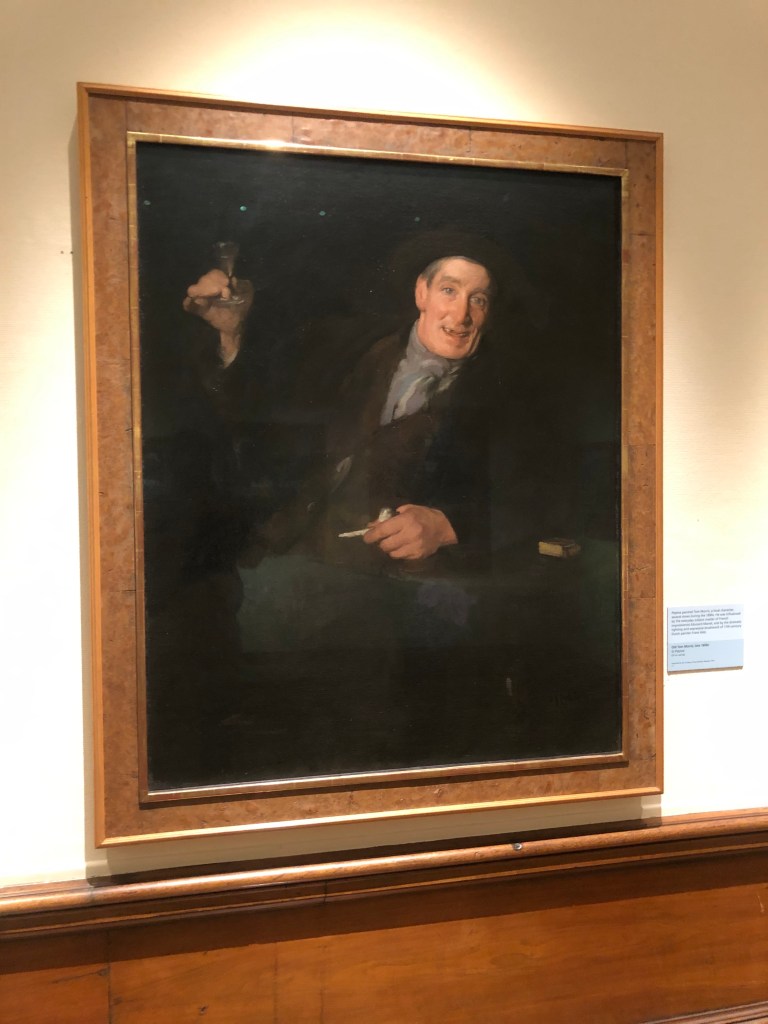
“Old Tom Morris” by S. J. Peploe

I’d never heard of the Glasgow Boys– a group of anti-establishment painters, active in the late 1800s– but an exhibition of their work provided me with a whistle stop tour. Many of the pieces felt tailor made for a sentimental softie such as myself, with sensitive evocations of impossible rural scenes, whispered on to the canvases. They made me think of Thomas Hardy, another favourite of mine who conjured up an imagined past and set about defending it from corruption with vigour.

But the painting that struck me the most was not an idyllic landscape but a portrait. Emerging from a dark sea of paint, that barely hints at a room, is the bright face of Old Tom Morris, who leans on a wooden table and raises a dainty glass to us. The placard tells us that Tom Morris is a ‘local character’ who the artist, S.J. Peploe, painted multiple times. I think the term local character is brilliantly provocative– it animates the mischief and vitality that Peploe had encased in Tom’s frozen expression.

I think the incredible lightness of his portrayal is not only an attempt to reflect his nature but also a philosophical point being made by the artist. Tom represents the veracity of (then-) modern life that fascinated and inspired many of the Glasgow Boys and he is presented as the antidote to the artifice of academic painting of the time. In the wake of his smile, we feel the warmth of chatter down the local and the joy of our friends’ idiosyncrasies. It is a memorial not only to Old Tom Morris, but to the weightlessness afforded by sincerity and the sharp crunch of gravel on the walk home.

With this in mind, as I walked away from Tom’s radiance, I was reminded of a more recent phenomenon that seeks out an unfiltered reality. On TikTok and YouTube and Instagram there are thousands of videos of people featuring ‘ordinary’, often vulnerable, individuals as the basis of their content. Most recently, I have seen videos of street photographers approaching homeless people to take their portrait.

On the one hand, it can seem fairly harmless, or even positive. We can cut through the sanctimonious, hateful bullshit of the media and the widespread ignorance of the social internet and be placed face-(to-screen)-to-face with a person, rather than a contrived and deliberately divisive caricature. They are made real for those who might otherwise dismiss them as an inconvenient and distant artefact. Their humanity is insisted upon and their dehumanisation made much harder– though some people, no doubt, continue to try their best.

But they also become an object for the creator and a tool that ultimately tells a story that they have no control over; a convenience, a fable. A lot of the time accompanying captions and comments show just how easily the individual can sink below the surface of platitudes and life lessons like ‘never judge a book…’ and ‘we are all one human race’. Is it really imbuing someone with dignity to broadcast their life for another’s gain, even if it is under the guise of ‘art’ or ‘creation’? Sometime the artists themselves can see their intended narrative spiral out of control.

An even more contentious version of the same phenomenon is the filming of homeless people being given money or food by the creator. Again, it can be useful to highlight good deeds and humanise a marginalised group, but can we truly be comfortable as an unsuspecting bystander is immortalised, and consumed into a memorial to the harsh realities of our society.
Granted, the question of how Old Tom Morris would feel about being painted if he had know he would be hanging on the walls of the Kelvingrove as a kind of zany embodiment of provincial life seems a bit inconsequential. But for the modern subjects, who are captured in the much more immediate mediums of photography and video, it seems like a very pertinent consideration to make.

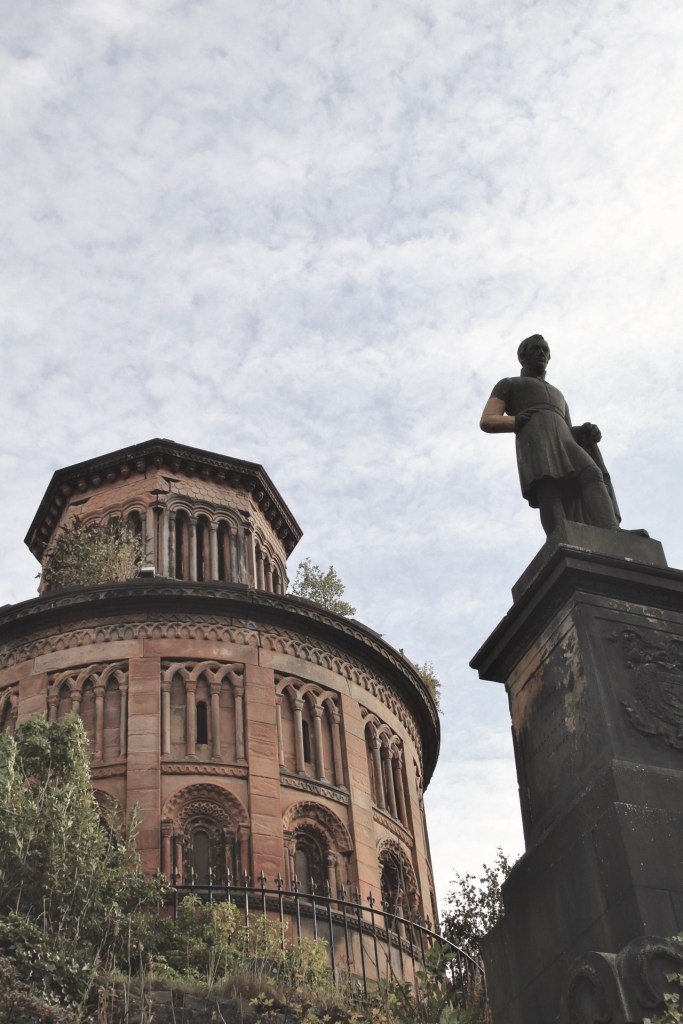
The next day we went to see some more literal memorials. The Glasgow Necropolis is a strange place, if I’m honest. The paths wind breathlessly up a hill, lined with dull stones in a multitude of greys. This is the antithesis of Old Tom Morris saluting the passing museum guests. This is a performance, a most silent and still song and dance.

See the tallest column and largest name and think of me, not as I was or ever could be.
There is no truth to discover, really, because we’re forced to accept their story as it is carved before us. The cloud of sorrow barely dampens the shrill ring of wealth that echoes around the extravagant tombs and statues. But the artifice is also fragile. Another group walks a few feet behind us and laughs at some apparent contradiction chiseled into the stone. Like our painting in reverse, the humanity seeps through the facade. Suddenly the desperation is all around, the human tragedy of monuments built to assert the agency of the dead makes the faces of statues cry.

Memorials are for the living, and those who once lived. More is revealed in the way we react to them than to the things themselves or, obviously, by the people and things they memorialise. Each sacred thing takes a piece of each person who spends a while with it, and that is it’s power.

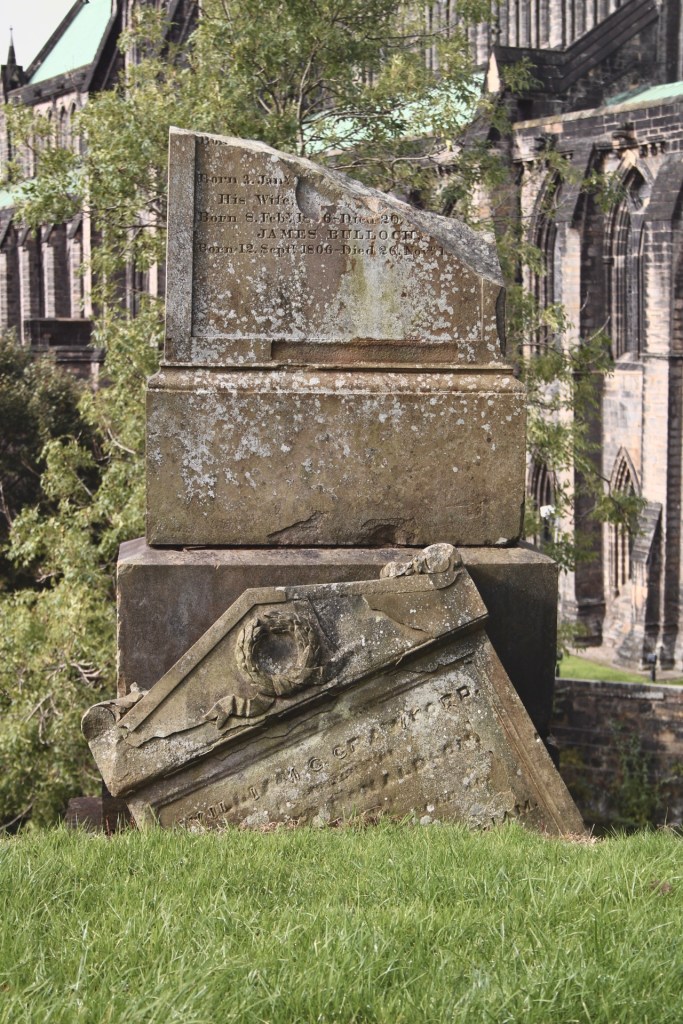
As we left and headed down toward the cathedral, we walked past a headstone torn in half down the middle like Styrofoam. I felt the sting of sadness and shook my head, as though for them but really for me.

Ultimately, we end up as the interpretations of those we surround ourselves with and those who choose to surround us. It is empowering and debilitating all at once but the contradiction persists at a kind of equilibrium. We should give care to our interpretations, and be sceptical of the lenses through which others are portrayed.

From a crowded wall at Kelvingrove

Old Tom Morris beams

Towards the muted audience

Those eyes seem glad to see.

“Here you see the everyman

I’ve caught and brought to view.

The meting of his dignity

I will entrust to you.”

This is Old Tom’s legacy:

One thump of beating heart.

So, did he know the consequence

Of this shallow part

You wrote for him, then silenced

His laugh with tender strokes,

And turned his face to playing ground

For reflection-seeking folks.

That is not Tom Morris,

Who’s collapsing into view.

Tom just holds a mirror up

And takes a piece of you.
‘Personal Mythologies’ in Dublin and Kyiv

In my second year at university I wrote an essay for a Gothic Literature module where I discussed the use of what I called ‘personal mythologies’ within two texts. Rereading it again today, the argument is convoluted to say the least (and the marks it received certainly reflects the content) but I found myself thinking again about the idea of personal mythologies over the past few weeks and thought I’d give it another go.

Mysterious Statue with Symbolic Resonances

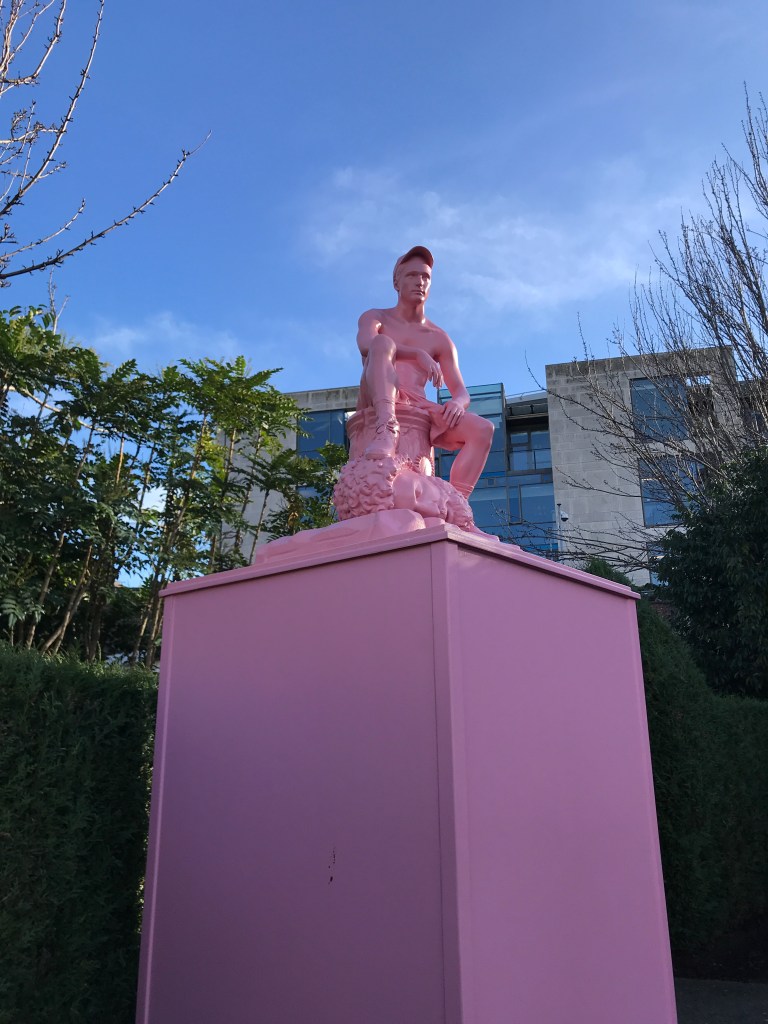
A few weekends ago I was presented with the extremely generous gift of a trip to Dublin to watch a band called ‘The High Kings’ who play traditional Irish folk songs, mixed in with some original material, and who’s music I have been slightly obsessed with for a few years.* We filled the time around the show with some sightseeing; taking a walking tour around the city and visiting Dublin Castle as well as spending a fair few hours in the local Wetherspoons. Dublin has the familiar murmur of a European capital, with towering statues with stony faces, but on a bitter but clear day we were most enamoured with its parks. We walked along criss-crossing paths and past still, cropped grass to find a reclining statue of and tribute to Oscar Wilde. In another garden, next door to Dublin Castle, we found a bright pink statue of a hero with a decapitated head at his feet. But, rather than classical dress, he was dressed in shorts, boots and a baseball cap. I couldn’t find any information on it online and there was no plaque to tell me its origin but, looking back, it was the perfect symbol of the appropriated and personalised mythologies that would occupy my thoughts in the coming weeks.

Our time exploring the city actually provided some pretty vital context for the songs I was going to hear from The High Kings. The songs are a performance of a national story; of a troubled history and a celebration of independence, often to used to punctuate a particular moment in time. But as they raced through their repertoire, they told the crowd their own stories about the first time they played a song or the musical traditions of their families.

Best £15 Ever Spent

During these stories it occurred to me that, separate from their wider context, the songs had become intertwined with the personal narratives of the band. Not only would the songs be a form of national mourning or nostalgia but footnotes in their own mythology; a soundtrack of firsts, lasts and defining moments. It was Paul O’Brien’s first time on tour with the band and maybe, amongst the performance of a long tradition, a moment in a particular show and particular song solidified itself within his personal mythology. Maybe his worst nerves, his strongest solo, the response of a crowd– something which will shape his life in minute but meaningful ways and which will be recalled, even if only inwardly, forever.

Only a few hours earlier I was sat in a pub called O’Connell’s and, sitting down with my cider (scared of Guinness), I saw the table was littered with fresh paper coasters. Instinctively, I placed one at the edge of the table and began flipping it, then catching it in midair– stacking another coaster on top with each attempt. I first saw this little trick many years ago, shown to me by a friend, and whom now I remember every time I am compelled to replicate it. I uploaded it to my Instagram and soon a second friend responded to the video, reminiscing about our time spent practising together. The origin stories of those quirks, manifesting in our daily lives, really fascinates me, especially when they are shared with a friendship group to become a common language and the foundation of how we think of and define ourselves.

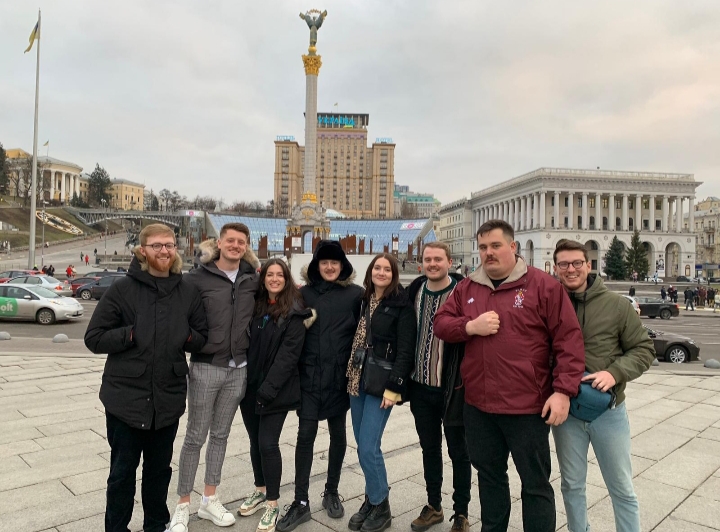
Fastforward a week and I was catching a flight to Kyiv for a trip with a altogether different pace. A group of eight, patiently led by a friend of mine who I lived with at University and whose family is from Ukraine. In a way, he was my Ukrainian ‘High King’, proud of the country and very vocal about its, often turbulent, national story (although he is yet to start a Ukrainian folk band, as far as I’m aware).** I think a lot of us are guilty of shit-talking our hometowns and failing to ever un-ironically praise them– especially Lutonians– but spending time with someone who has a sincere and unashamed enthusiasm for a place that is important to them is really refreshing. The cityscape of Kyiv is beautifully eclectic; with the blunt grey leviathans of brutalism interspersed with glittering monuments and intricate exteriors coloured with pastel blues and pinks. As a train station nerd, the stretches of tunnel lit warmly with a row of chandeliers and the delightfully retro rolling stock made me happy.

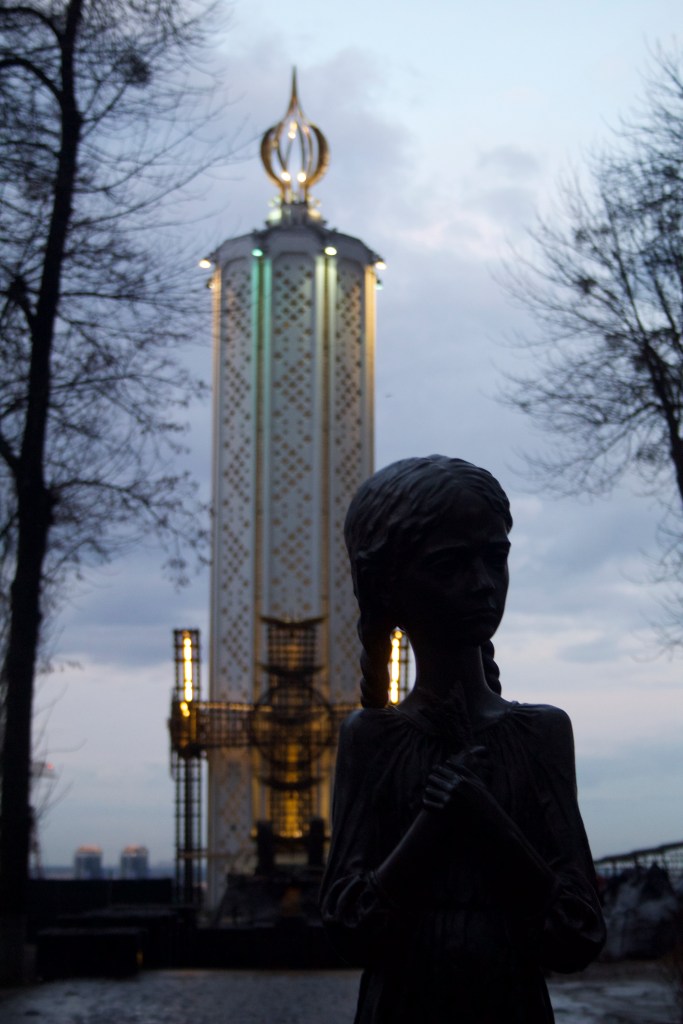
Statue of a young, starving girl commemorating the Holodomor

We had gone to Kyiv for my friend’s birthday and the party consisted mostly of his school friends whom he had known, and who had known each other, for many years. While the evolving story of this new city sharpened into view, it was so fascinating to me hearing them delve into the depths of their own shared mythology; being able to evoke meaning and nostalgia with the recalling of a name or place. And, when asked, they would generously offer up the genesis of long standing jokes that are so engrained in the fabric of their friendship. Even the UoB alumni partook in some of our own folk traditions, sharing our own origins, with stories of short-lived friendships and habitual clubbing. As the second annual pilgrimage to Ukraine in celebration of a friend, more sprouts of a common language, borne out of shared experience, began to emerge.

We were in our own bubble as the bells chimed for Brexit back home. And perhaps it is in this seemingly eternal saga that the more insidious manifestations of these ‘shared mythologies’ rear their ugly heads. These stories we wrap ourselves are exclusionary by nature, they make us prone to outrage with those whose thoughts divert from ours and distract from the need to acknowledge the lived experience of others.

Brutalist Architecture

Surprisingly, I don’t have the answers to how we ‘unify’ or ‘come together’ (as we are so often told we must do) but I thought I would end on a slightly less controversial topic. On our final night, the conversation arrived at the topic of astrology. Now, I suspect there were varying degrees of ‘belief’ in the room but I found myself thinking how a younger, more insufferable, version of myself may have reacted. In my mid-teens I was a boring, smart arse contrarian that watched Christian take-down videos and posted trite societal observations on Facebook (somethings never change) and astrology would have no doubt been another victim of my distain. But thinking of the way we consume these structures and we become reliant on them as truths not only about the world but about ourselves, I’m glad I tried to understand and defend the validity of belief in that moment. Often, we want the same thing; security, control, happiness, love. As we shoot across no mans land, with different uniforms but the same anxieties and fears and the same locket with a picture of your sweetheart back home.

As I attempt to keep this straining metaphor alive, if there is a lesson I think I’ve learnt (or, added to my anthology of origin stories) it’s to try to see the reasons people have built the mythology upon which they stand. See that it can give meaning, bring solace and find space for new footnotes or chapters in your own story.

* My personal recommendations on where to start with The High Kings are ‘Grace’, ‘Red Is The Rose’, ‘Rocky Road to Dublin’ and ‘Marie’s Wedding’

** He does, however, have a blog that follows Ukrainian football so, if that interests you, you can find him at Zorya Londonsk.

Shaw’s Corner: A Lesson in Not Meeting Heroes

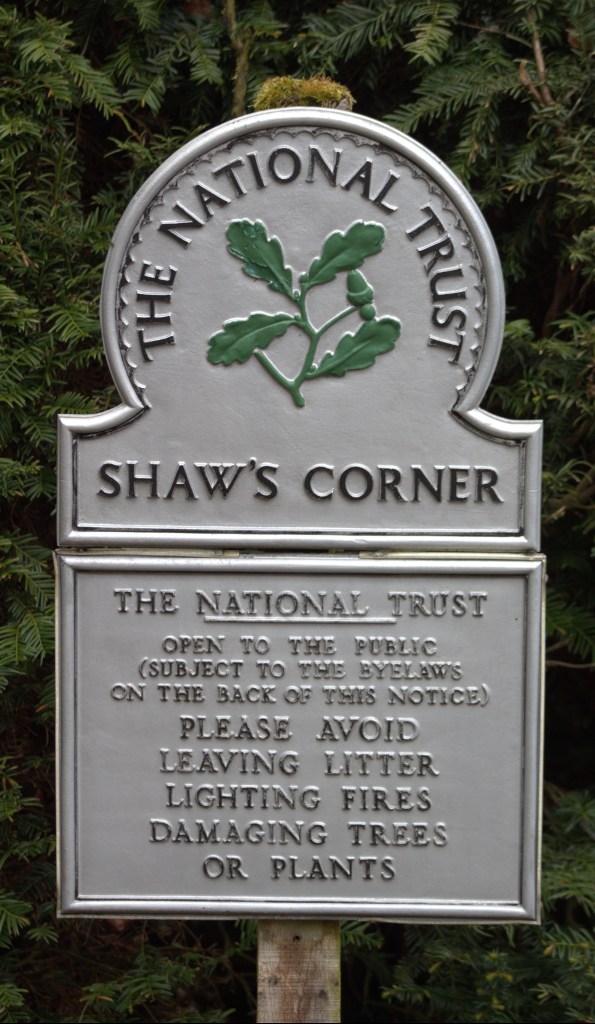
The other day I went to Shaw’s Corner. The former residence of Irish playwright George Bernard Shaw; or GBS to his friends (not really). Now I didn’t really know anything about Shaw: I came across him in passing during my undergrad, I knew he wrote Pygmalion, which was adapted into My Fair Lady, but almost nothing else. I was only there because of its proximity to me and my need to try out a new camera, so I went in with an open mind. The house is quite remote, at the end of a series of long, empty roads with blind corners, lined with thick bushes and trees– the fair weather made the journey feel like a summer road trip . You arrive first in the car park, with dusty, crunchy gravel underfoot, a silver food truck and a hut housing all the Bernard Shaw-themed merchandise you could want.

We walked in to the hut and scan our membership cards and left feeling very smug and self-satsfied after being congratulated for having young person’s memberships (for we are the vibrant, promising future of the National Trust). The house itself is obscured by tall hedges along one side of the car park, but once they are rounded the house pops into view. It’s an odd sight. The walls, a reddish-brown brick accented with bright green pipes and window frames, seem to jut out at random and three rooftop chimneys complete its unusual silhouette. It feels like something out of The Hobbit or a Wordsworth poem, the greenery that clings to so much of the walls make it seem like the house itself might have sprouted from the ground.

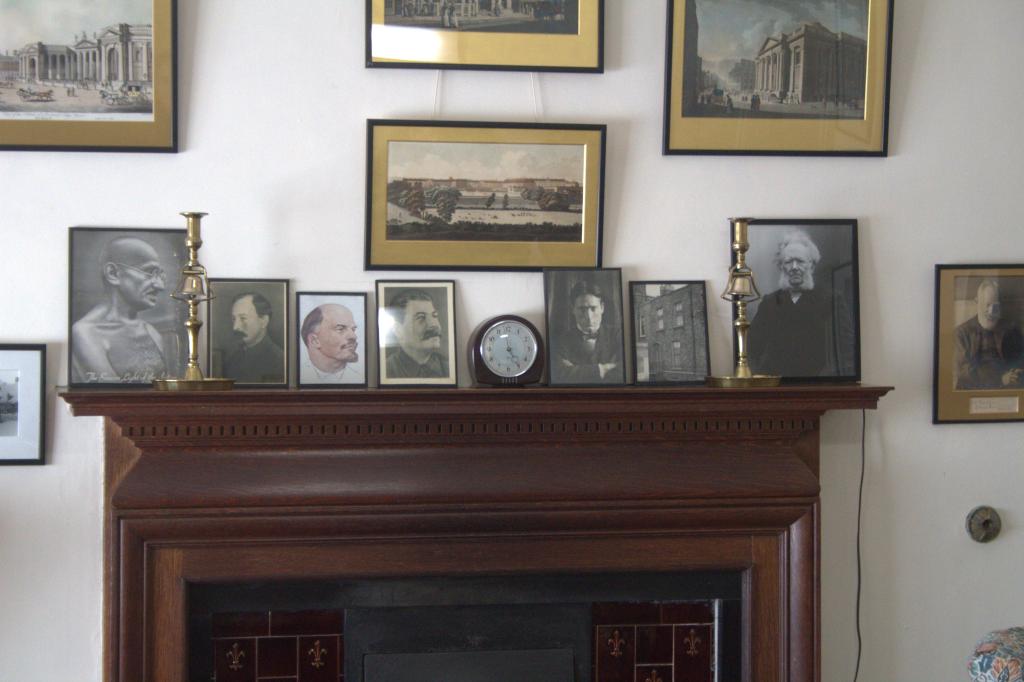
Shaw’s Wall of Portraits

While the gardens are lovely, it was the inside of the house that I found the most interesting. For the most part it is fairly unspectacular, a big green door opens into a room with off-white walls and framed photos and paintings surround another clutter of off-white doorways that lead to more rooms. The furniture is frail, the decoration old-fashioned with gaudy flower patterns adorning the greenish-white curtains. But one particular decoration really hadn’t aged well. Along the top of one fireplace was a row of photos and drawings: first I noticed a photo of Gandhi… then Lenin, then Stalin. It turns out that Shaw was a dedicated socialist, eugenics enthusiast, dictator admirer and crackpot who thought Hitler should be allowed to escape retribution after WWII and retire to a quiet life in Ireland. It made the old curtains seem positively progressive.

A view of Shaw’s Corner from the gardens

Up the stairs, in the former room of Shaw’s wife Charlotte, was the ‘museum room’. On the wall were flowery quotes and extracts from letters, written by Bernard Shaw. Unfortunately for Charlotte, the letters were not addressed to her but to one “Mrs Pat”. Mrs Patrick Campbell, an actress and socialite, was inspiration for many of Shaw’s characters and, once they began negotiating her appearance as Eliza Doolittle in Pygmalion, the two began an intense relationship and exchange of passionate letters. Although Wikipedia tells me it was an ‘unconsummated’ relationship, I’m sure Shaw’s obsessive gushing didn’t please his wife.

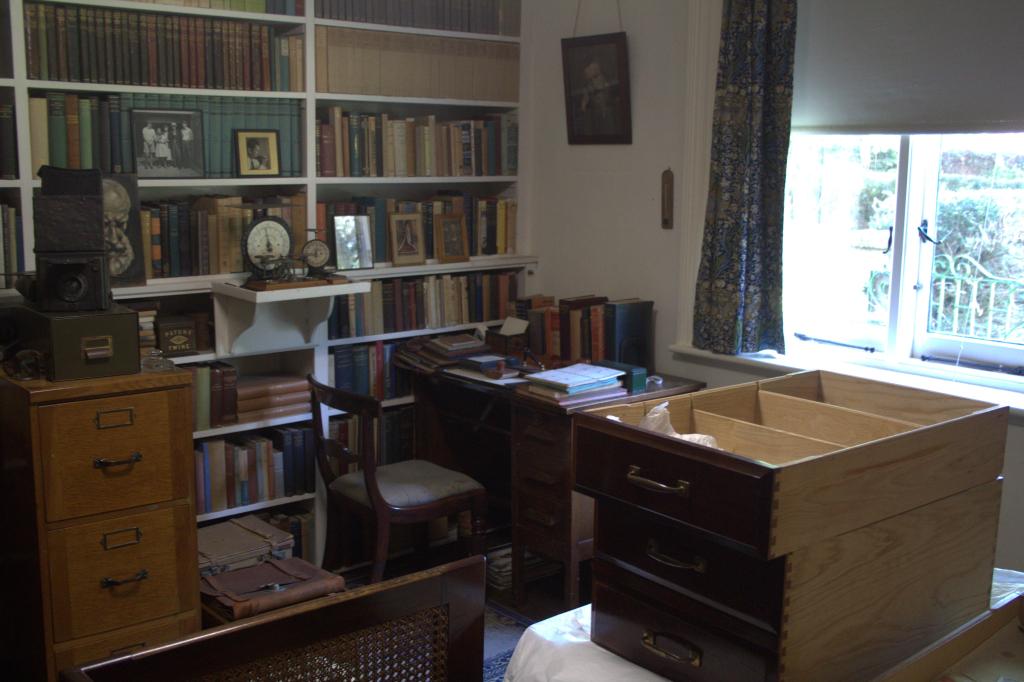
A room full of books in Shaw’s Corner

The whole thing reminded me of Thomas Hardy who developed similar infatuations with female acquaintances. Florence Henniker, a writer with whom Hardy eventually collaborated, was forced to reject his romantic advances (despite his being married at the time), although was later used as inspiration for Sue in his final novel Jude the Obscure.

Later in life, the actress Gertrude Bugler became an object of interest for the now eighty-year-old Hardy as she played the leading roles in the stage adaptations of many of his novels. This time, when Gertrude was due to star in Tess of the D’Urbervilles in London, Hardy’s second wife gave in to her jealousy and refused to allow it. While I don’t have Thomas Hardy posters on my wall or drift off to sleep listening to his poetry, it leaves a slightly bitter taste when someone who’s work you admire has their raw, unfiltered character revealed to you.

All this made me think of how we deal with the complexity of our cultural heroes. George Bernard Shaw is undoubtedly significant, his work should be read and not thrown out along with his troubling personal philosophies. I am glad that the photo of Stalin remains on the fireplace as a record of Shaw’s reality, but it seems to be just an inconvenient footnote attached to a monument to his brilliance. And I concede that the house may exist as just a snapshot of a famous person’s life for posterity but the National Trust website just delivers a watered down version of Shaw’s socialism that feels a bit intellectually insincere; a way to justify the celebration of the man. But it has to be possible for people to exist both as venerated celebrity and flawed human.

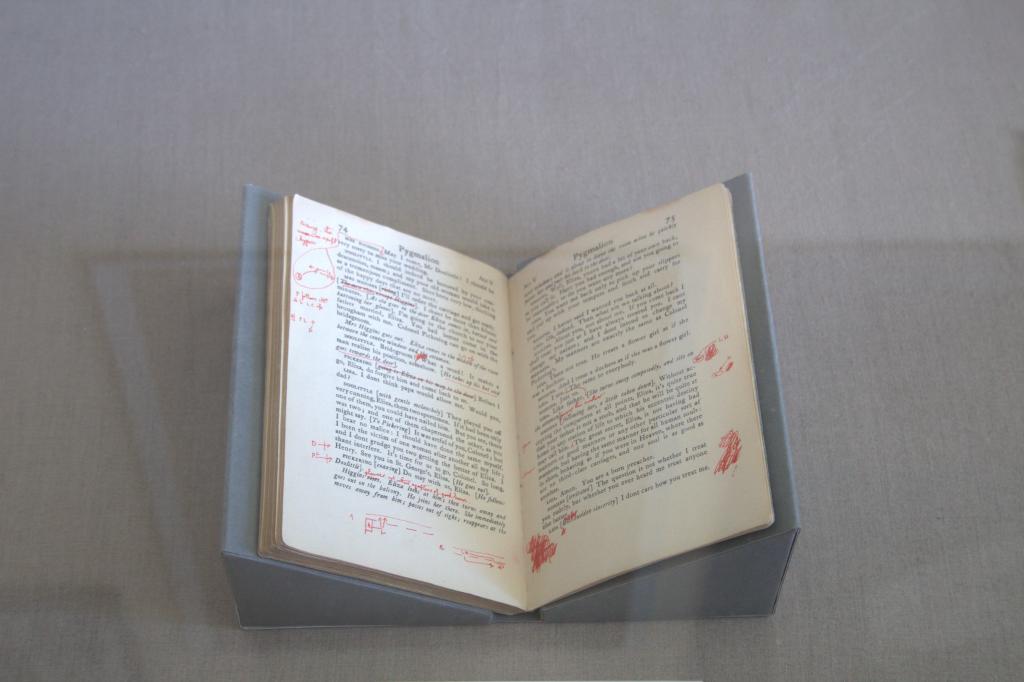
An annotated manuscript

In the social media-influenced dialogue, however, it seems that there is a shrinking space for complexity and nuance. I think ‘Cancel Culture’, perhaps rather controversially, can be a useful phenomenon… sometimes. When a public figure’s reputation is so concretely positive and elevated, it can take a collective effort to pierce the facade of perfection. But, in a sphere where everyone craves clickable, shareable and digestible opinions, people must be heroes or villains– and the distance between those two states seems to be shrinking.

In the current climate, this piece could be considered a concrete cancellation of George Bernard Shaw, and the National Trust’s literary hero becomes a villain. But I think really it is just unveiling another aspect of a messy, human life and, while it takes more effort to untangle appreciation for achievements from dogma and ideology, it makes for a far more interesting story. Surely Winston Churchill can be both a white supremacist and unalterable enmeshed with the story of Allied victory in WWII and any complete deification or vilification is unhelpful. But perhaps those who were made victims at his hands would rightly call out my insistence on balance and nuance.

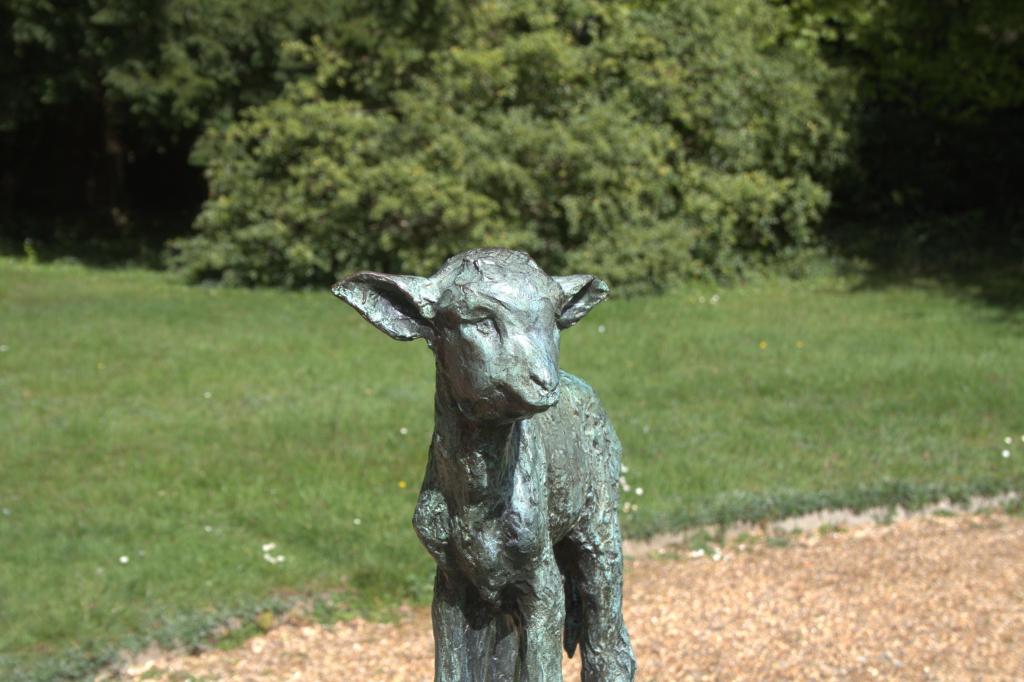
A statue in the gardens at Shaw’s Corner

I don’t know what the right answer is but what I have decided for myself is that not only should you not meet your heroes, you shouldn’t make them in the first place. And as we were leaving Shaw’s Corner, we went up to the silver food truck and bought a couple of drinks. While the girl was grabbing them she told us about Shaw’s office in the gardens outside the house. ‘It rotates so he could face the sun whenever he wanted, ‘ she told us, ‘and he called it London, so his housekeeper could tell unwanted guests that he was away in the capital’. I chuckled thinking about the clever system and decided perhaps one should not meet their villains, either.

The ‘Roman Ruin’ at Schönbrunn Palace

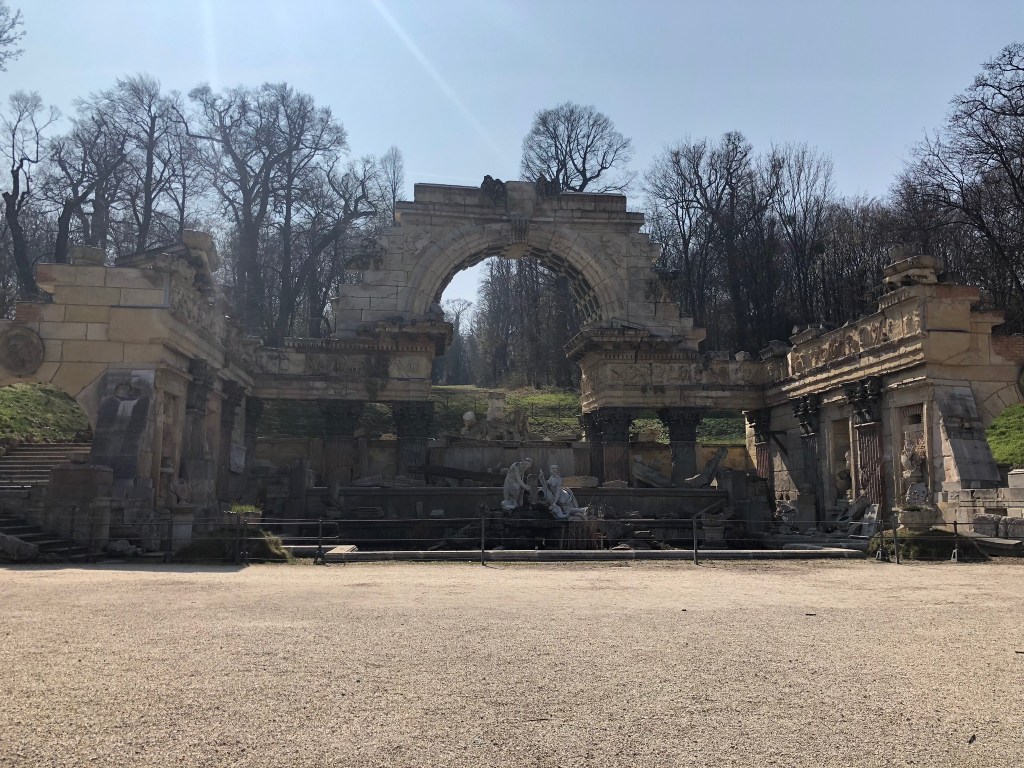
The “Roman Ruin”

In the vast gardens of Schönbrunn Palace in Vienna, at the end of one of the many gravel pathways, is the Roman Ruin. A pale yellowy arch, held aloft by the typical tree-trunk pillars and flanked by two walls which create a kind of courtyard. Scattered everywhere are chunks of stone and broken ornaments, the decoration on pillars and walls are cracked and everything was layered with the dirt of passed time. Turns out, none of this stuff is Roman. It’s not even technically a ruin. It is a scene, carefully constructed in 1778 to look like a ruin from antiquity. This practice wasn’t even uncommon, the fuck-off-rich people of the 18th Century often turning to the fake ruin as the pièce de résistance of their massive gardens.

One of the many paths running through the gardens

Although I’d like to say I knew straight away that it was definitely fake, that I could recognise the materials weren’t as old as they ought to be, I really wasn’t sure . But once I found out after, and thought about it a little bit, it seemed quite ridiculous to me. I (as illustrated by the content of this blog) love old stuff but would I want to have a fake old thing built, at huge expense, in my back garden? Isn’t the appeal of old things that they’re actually old, that you have something that brings you closer to history, an object enchanted by the passing of time.

But the more I thought about it, the less strange and more familiar the idea seemed. Last year I had a weekend in Grantham and stayed at a very beautiful hotel with a garden; tightly cut grass sat underneath old, stoic trees and a neat path traced through it. Having seen the pictures beforehand, I packed a pair of trousers, a white linen shirt and a pair of brown brogues and for parts of the trip I pretended in my mind to be a character in a Poirot novel. This was heightened by the fact that we went to a speakeasy-themed cocktail bar and got suitably drunk. Now obviously I know that it wasn’t a real speakeasy, and that the facilities of this hotel far exceeded those of an Interwar equivalent, but it was fun play pretend and to indulge in the feeling of history. It isn’t always about veracity or authenticity but also mapping those conceptions we hold about periods of time onto our own lives and bathing in that kind of nostalgia. While I was dressing up binge-drinking as a classy evening out in a 1920s bar, maybe the Hapsburg’s were borrowing their own associations of antiquity to attach to themselves.

It’s the same compulsion that leads people to take Polaroid photos or even get an app on their phone that mimics a Polaroid. The photo is captured in poorer quality but it also imbues it with a kind of importance and it implies it must be treated with the reverence of an old, special, and thus preserved, object. People makes movies on film, artists record songs on vinyl and, while both can be artistic choices, these processes are often used as a shortcut to nostalgia and significance regardless of the actual content. But of course, the romantic, idealised past is a tool that comes in forms a lot more malignant than Instagram filters.

The irony of the ruins to me is that they have come to mirror the decline Schönbrunn Palace itself. The crumbling Roman scene simultaneously pays homage to the ideals of that time period while acknowledging its decline and the need for it to be succeeded, presumably by the Hapsburg’s themselves. But while I walked around the Palace grounds and saw it full of common people like me, walking past the Emperor’s toilet, uncovering every aspect of their private lives, it showed the same decline the Hapsburg’s saw in the Romans, and the Romans in their predecessors. Both the Roman ruins and the palace itself stood as a kind of benign monument to the past, a way for us to satisfy our obsession with the past but to remember that we have moved on– changed. It amused me to think of the Emperors looking into their garden, disgusted to see me eating a whole packet of Tuc biscuits while listening to a boy playing Oasis songs through a small amp. I think for the most part, times change for the better– dynasties and empires fall and are replaced with different ideals and philosophies– but we must remember that we won’t be exempt from the relentless ‘progress’ of humanity and we will probably be reduced to our most quaint or romantic clichés.

As it so happens, there are some real Roman ruins in Vienna. You can see the remnants of walls and windows but the dirty reds and greys of the old brick walls make this sight a far less glamorous one. But does its realness make it more appealing or more worthy of adoration? I’m personally conflicted. On the one hand, the choice to fake a Roman ruin gives us an insight into the values of the people that desired it, their admiration for the beauty of classical forms and structures, their dancing with the past and its connotations that feels so familiar. But on the other hand, there isn’t really a shortcut to nostalgia. I think the real relics from history earn their feeling of enchantment over time and the people responsible for those relics are stuck with whatever conceptions develop of them and their artefacts. Just as it isn’t the grainy, distorted overlay of a Polaroid that evokes the feeling of love or longing or grief within a picture but the truth and the story that the picture contains.