In my second year at university I wrote an essay for a Gothic Literature module where I discussed the use of what I called ‘personal mythologies’ within two texts. Rereading it again today, the argument is convoluted to say the least (and the marks it received certainly reflects the content) but I found myself thinking again about the idea of personal mythologies over the past few weeks and thought I’d give it another go.
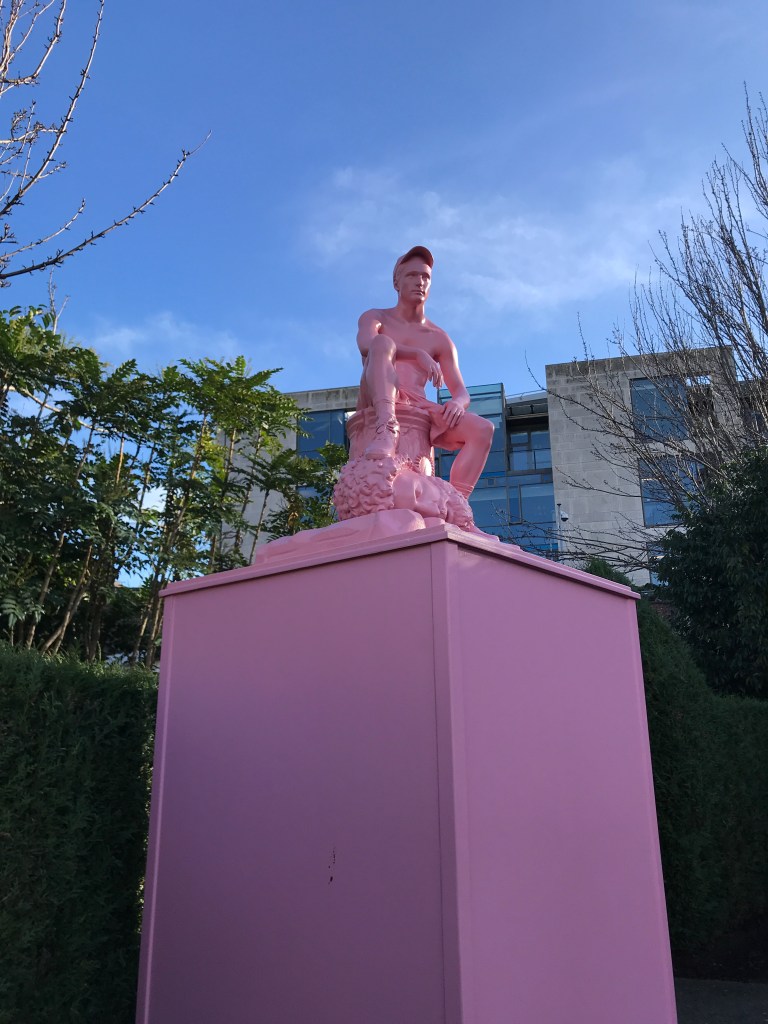
A few weekends ago I was presented with the extremely generous gift of a trip to Dublin to watch a band called ‘The High Kings’ who play traditional Irish folk songs, mixed in with some original material, and who’s music I have been slightly obsessed with for a few years.* We filled the time around the show with some sightseeing; taking a walking tour around the city and visiting Dublin Castle as well as spending a fair few hours in the local Wetherspoons. Dublin has the familiar murmur of a European capital, with towering statues with stony faces, but on a bitter but clear day we were most enamoured with its parks. We walked along criss-crossing paths and past still, cropped grass to find a reclining statue of and tribute to Oscar Wilde. In another garden, next door to Dublin Castle, we found a bright pink statue of a hero with a decapitated head at his feet. But, rather than classical dress, he was dressed in shorts, boots and a baseball cap. I couldn’t find any information on it online and there was no plaque to tell me its origin but, looking back, it was the perfect symbol of the appropriated and personalised mythologies that would occupy my thoughts in the coming weeks.
Our time exploring the city actually provided some pretty vital context for the songs I was going to hear from The High Kings. The songs are a performance of a national story; of a troubled history and a celebration of independence, often to used to punctuate a particular moment in time. But as they raced through their repertoire, they told the crowd their own stories about the first time they played a song or the musical traditions of their families.

During these stories it occurred to me that, separate from their wider context, the songs had become intertwined with the personal narratives of the band. Not only would the songs be a form of national mourning or nostalgia but footnotes in their own mythology; a soundtrack of firsts, lasts and defining moments. It was Paul O’Brien’s first time on tour with the band and maybe, amongst the performance of a long tradition, a moment in a particular show and particular song solidified itself within his personal mythology. Maybe his worst nerves, his strongest solo, the response of a crowd– something which will shape his life in minute but meaningful ways and which will be recalled, even if only inwardly, forever.
Only a few hours earlier I was sat in a pub called O’Connell’s and, sitting down with my cider (scared of Guinness), I saw the table was littered with fresh paper coasters. Instinctively, I placed one at the edge of the table and began flipping it, then catching it in midair– stacking another coaster on top with each attempt. I first saw this little trick many years ago, shown to me by a friend, and whom now I remember every time I am compelled to replicate it. I uploaded it to my Instagram and soon a second friend responded to the video, reminiscing about our time spent practising together. The origin stories of those quirks, manifesting in our daily lives, really fascinates me, especially when they are shared with a friendship group to become a common language and the foundation of how we think of and define ourselves.
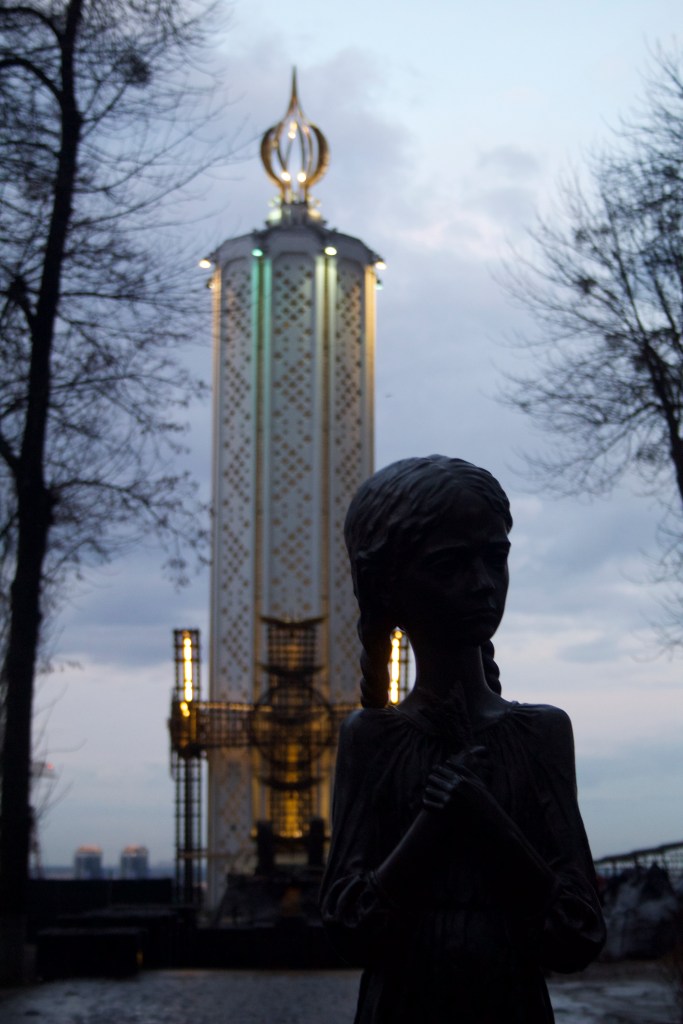
Fastforward a week and I was catching a flight to Kyiv for a trip with a altogether different pace. A group of eight, patiently led by a friend of mine who I lived with at University and whose family is from Ukraine. In a way, he was my Ukrainian ‘High King’, proud of the country and very vocal about its, often turbulent, national story (although he is yet to start a Ukrainian folk band, as far as I’m aware).** I think a lot of us are guilty of shit-talking our hometowns and failing to ever un-ironically praise them– especially Lutonians– but spending time with someone who has a sincere and unashamed enthusiasm for a place that is important to them is really refreshing. The cityscape of Kyiv is beautifully eclectic; with the blunt grey leviathans of brutalism interspersed with glittering monuments and intricate exteriors coloured with pastel blues and pinks. As a train station nerd, the stretches of tunnel lit warmly with a row of chandeliers and the delightfully retro rolling stock made me happy.
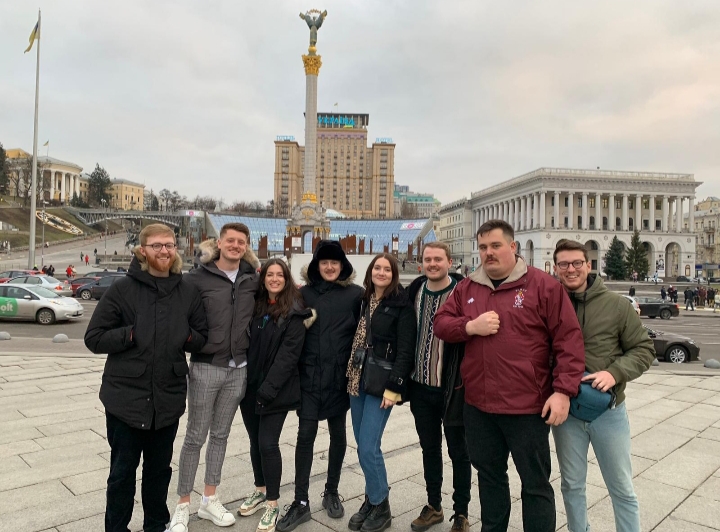
We had gone to Kyiv for my friend’s birthday and the party consisted mostly of his school friends whom he had known, and who had known each other, for many years. While the evolving story of this new city sharpened into view, it was so fascinating to me hearing them delve into the depths of their own shared mythology; being able to evoke meaning and nostalgia with the recalling of a name or place. And, when asked, they would generously offer up the genesis of long standing jokes that are so engrained in the fabric of their friendship. Even the UoB alumni partook in some of our own folk traditions, sharing our own origins, with stories of short-lived friendships and habitual clubbing. As the second annual pilgrimage to Ukraine in celebration of a friend, more sprouts of a common language, borne out of shared experience, began to emerge.
We were in our own bubble as the bells chimed for Brexit back home. And perhaps it is in this seemingly eternal saga that the more insidious manifestations of these ‘shared mythologies’ rear their ugly heads. These stories we wrap ourselves are exclusionary by nature, they make us prone to outrage with those whose thoughts divert from ours and distract from the need to acknowledge the lived experience of others.

Surprisingly, I don’t have the answers to how we ‘unify’ or ‘come together’ (as we are so often told we must do) but I thought I would end on a slightly less controversial topic. On our final night, the conversation arrived at the topic of astrology. Now, I suspect there were varying degrees of ‘belief’ in the room but I found myself thinking how a younger, more insufferable, version of myself may have reacted. In my mid-teens I was a boring, smart arse contrarian that watched Christian take-down videos and posted trite societal observations on Facebook (somethings never change) and astrology would have no doubt been another victim of my distain. But thinking of the way we consume these structures and we become reliant on them as truths not only about the world but about ourselves, I’m glad I tried to understand and defend the validity of belief in that moment. Often, we want the same thing; security, control, happiness, love. As we shoot across no mans land, with different uniforms but the same anxieties and fears and the same locket with a picture of your sweetheart back home.
As I attempt to keep this straining metaphor alive, if there is a lesson I think I’ve learnt (or, added to my anthology of origin stories) it’s to try to see the reasons people have built the mythology upon which they stand. See that it can give meaning, bring solace and find space for new footnotes or chapters in your own story.
* My personal recommendations on where to start with The High Kings are ‘Grace’, ‘Red Is The Rose’, ‘Rocky Road to Dublin’ and ‘Marie’s Wedding’
** He does, however, have a blog that follows Ukrainian football so, if that interests you, you can find him at Zorya Londonsk.

 Uncultured Review